


Learning how to crochet for beginners step by step with pictures becomes much easier when every hand movement has a clear purpose. You need only a crochet hook, one ball of smooth yarn, scissors, and a yarn needle to begin.
This complete beginner crochet tutorial explains how to make a slip knot, hold the hook and yarn, create a foundation chain, work single crochet, turn rows, count stitches, correct mistakes, and finish an easy washcloth. Each important technique includes an editor-only picture note so you can place an original close-up photograph beside the exact instruction it demonstrates.
By the end, you should be able to recognize basic stitch anatomy, read a simple written pattern, and complete a square single-crochet project without guessing where the hook belongs.
Beginner Crochet at a Glance
Use this overview as a quick reference while learning how to crochet for beginners step by step with pictures, especially when choosing yarn, a hook, and a first project.
| Item | Recommendation |
| Skill level | Absolute beginner |
| Best first yarn | Smooth, light-colored number 4 medium-weight yarn |
| Suggested starting hook | 5.5 mm, or the size recommended by the yarn label |
| First stitches | Slip knot, chain, and single crochet |
| First project | Approximately 8-inch single-crochet washcloth |
| Main beginner goal | Keep the same stitch count in every row |
| Terminology | U.S. crochet terms |
Quick Answer: How Do Beginners Start Crocheting?
This quick sequence summarizes how to crochet for beginners step by step with pictures before the detailed lesson begins.
To crochet, make a slip knot on the hook, create a foundation chain, work a basic stitch into that chain, and repeat the stitch in rows. Count every row, fasten off the final loop, and weave in the yarn tails.
Follow this beginner sequence:
- Choose medium-weight yarn and a suitable crochet hook.
- Make a slip knot and place it on the hook.
- Hold the hook in your dominant hand and control the yarn with the other hand.
- Yarn over and pull the yarn through the loop to make a chain.
- Create a foundation chain.
- Insert the hook into the second chain from the hook.
- Work single crochet stitches across the chain.
- Chain one, turn the work, and crochet the next row.
- Continue until the fabric reaches the required size.
- Cut the yarn, fasten off, and weave in the ends.
Your first stitches may look uneven. That is normal. Consistent tension develops through repetition rather than force.
Can Anyone Learn to Crochet?
Yes. Crochet is a skill that can be learned by almost anyone with patience and regular practice.
Many beginners worry that they are not naturally creative or coordinated enough to crochet. In reality, crochet is built from a small number of repeatable movements that become easier with repetition.
Most new crocheters can learn:
- How to make a slip knot
- How to create chain stitches
- How to work single crochet
- How to turn rows
- How to count stitches
within their first few practice sessions.
The goal is not perfection. The goal is understanding how the yarn, hook, and stitches work together. Consistency develops naturally over time.
Key Takeaways
These key points reinforce the most important lessons in how to crochet for beginners step by step with pictures without overwhelming a new learner.
- Crochet is created by pulling loops of yarn through other loops with a hook.
- Medium-weight, smooth, light-colored yarn is usually easier for beginners to see and control.
- The slip knot and loop currently on the hook are not normally counted as chain stitches.
- Single crochet is an excellent first fabric-making stitch.
- Count the stitches in every row to keep the sides straight.
- Use stitch markers to identify the first and last stitch.
- A larger hook creates looser stitches, while a smaller hook generally creates tighter stitches.
- Crochet patterns may use either U.S. or U.K. terminology.
- Mistakes can normally be removed by pulling the yarn back to the point before the error.
- A square washcloth is an ideal first project because it requires only basic rows and does not need precise garment sizing.
- Original close-up pictures should show the exact insertion point, loop count and finished result for each major step.
What Is Crochet?
Understanding the craft itself provides useful context for anyone studying how to crochet for beginners step by step with pictures.
Crochet is a yarn craft in which a hook is used to form loops and pull them through other loops. These connected loops become stitches, and the stitches combine to create fabric.
Crochet can be used to make:
- Blankets
- Scarves
- Hats
- Bags
- Washcloths
- Coasters
- Sweaters
- Toys
- Home decorations
- Lace
- Baskets
- Amigurumi figures
Most crochet projects begin with one of three foundations:
- A foundation chain
- A magic ring
- A foundation stitch
This beginner tutorial starts with a traditional foundation chain because it teaches the hand movements used in many crochet patterns.
Is Crochet Hard for Beginners?
A realistic explanation of early challenges makes how to crochet for beginners step by step with pictures feel more achievable and less frustrating.
Crochet can feel awkward during the first practice session because both hands perform different jobs. One hand moves the hook, while the other controls the working yarn and holds the growing fabric.
The most common early difficulties are:
- Holding the yarn too tightly
- Making chains of different sizes
- Losing the first or last stitch
- Confusing the working loop with a completed stitch
- Struggling to insert the hook into tight chains
- Adding accidental stitches
- Skipping stitches
- Turning the work incorrectly
These problems do not mean you are bad at crochet. They are part of learning how to coordinate the hook, yarn and fabric.
Do not expect your first row to look perfect. Focus on understanding the movement before trying to make every stitch identical.
Is Crochet Easier Than Knitting?
This is one of the most common questions beginners ask before choosing a yarn craft.
Neither crochet nor knitting is universally easier. However, many beginners find crochet easier to learn because there is usually only one active working loop on the hook at a time.
This can make it simpler to:
- Identify mistakes
- Undo stitches
- Recover from errors
- Learn basic techniques
Knitting offers its own advantages, including different fabric characteristics and drape, but crochet is often considered more forgiving during the learning process.
The best craft is the one you enjoy practicing consistently.
Crochet vs. Knitting: What Is the Difference?
This comparison helps readers decide whether how to crochet for beginners step by step with pictures matches the type of yarn craft they want to learn.
Crochet and knitting both create fabric from yarn, but they use different tools and construction methods.
| Feature | Crochet | Knitting |
| Main tool | One crochet hook | Usually, two knitting needles |
| Active loops | Usually, one main working loop | Multiple active loops remain on the needles |
| Basic techniques | Chain, single crochet, and double crochet | Knit and purl |
| Fabric structure | Formed by pulling loops through loops | Formed through connected rows of active loops |
| Correcting errors | Stitches can often be pulled back individually | Dropped stitches may travel through several rows |
| Beginner project | Washcloth, coaster or scarf | Washcloth or scarf |
Neither craft is universally easier. Some beginners prefer crochet because they normally manage only one active working loop at a time.
Crochet Supplies Beginners Need
The right supplies make how to crochet for beginners step by step with pictures easier because the stitches remain visible and the hook moves smoothly.
You do not need a complete crochet set to start. Purchase only the basic supplies until you know which yarns, hook styles, and projects you enjoy.
Essential Crochet Supplies
Keep this supply list nearby when following how to crochet for beginners step by step with pictures, so every tool is ready before practice begins.
| Supply | Beginner recommendation | Why it helps |
| Crochet hook | 5.5 mm hook or size recommended on yarn label | Large enough to handle comfortably without creating extremely loose stitches |
| Yarn | Medium-weight number 4 yarn | Thick enough to see individual stitches |
| Scissors | Small, sharp craft scissors | Produces a clean yarn end |
| Yarn needle | Large blunt-tipped tapestry needle | Used to weave in yarn tails |
| Stitch markers | Locking stitch markers or safety pins | Mark the first and last stitches |
| Measuring tape | Flexible craft measuring tape | Measures project width and length |
| Notebook or counter | Any simple recording method | Helps track rows and stitch counts |
Optional supplies include a row counter, yarn bowl, blocking mat, and ergonomic hook. These can be added later.
How to Choose the Best Yarn for Learning Crochet
Yarn choice strongly affects how to crochet for beginners step by step with pictures, particularly when a learner needs to see each loop clearly.
The yarn you choose can make your first experience easier or unnecessarily frustrating.
Beginner-Friendly Yarn Features
These yarn features support how to crochet for beginners step by step with pictures by reducing splitting, slipping and hidden stitches.
Look for yarn that is:
- Medium weight
- Smooth rather than fuzzy
- Light or medium in color
- Made from plied strands that stay together
- Easy to pull from the ball or skein
- Affordable enough for repeated practice
- Compatible with the hook size shown on its label
Yarn Weight Recommendation
A number 4 medium-weight yarn, also called worsted, aran, or afghan yarn in some markets, is a practical beginner choice. It is substantial enough to hold and makes the structure of each stitch relatively easy to see.
Best Yarn Fibers for Beginners
| Fiber | Advantages | Possible disadvantages | Suitable first projects |
| Acrylic | Affordable, widely available, and easy to wash | Some inexpensive yarns may split or feel rough | Practice squares, scarves and blankets |
| Cotton | Strong stitch definition and absorbent | Has less stretch and may feel firm in the hands | Washcloths, coasters and dishcloths |
| Wool | Elastic, warm, and forgiving | May require special washing and can irritate sensitive skin | Hats, scarves and cold-weather accessories |
| Wool blend | Combines elasticity with easier care | Usually costs more than basic acrylic | Scarves, hats and garments |
| Chenille | Soft and plush | Difficult to see stitches and may shed | Better after learning basic stitches |
| Mohair or fuzzy yarn | Decorative and lightweight | Stitches are difficult to identify and undo | Not recommended for a first lesson |
For your first practice swatch, choose a light-colored acrylic or cotton yarn. Black, navy, fuzzy, and heavily textured yarns can hide the loops you need to see.
How to Read a Yarn Label Before Crocheting
Reading the label correctly strengthens how to crochet for beginners step by step with pictures because it connects yarn weight, hook size, and care instructions.
A yarn label contains more information than the yarn’s brand and color. Learning to read it can help beginners choose a suitable hook, estimate how much yarn they need, and care for the finished project correctly.
| Yarn-label detail | What it tells you | Why it matters |
| Yarn weight number | The approximate thickness of the yarn | Helps you select a suitable project and hook |
| Fiber content | Whether the yarn contains cotton, acrylic, wool or another fiber | Affects softness, stretch, warmth and washing |
| Ball or skein weight | The physical weight of the yarn package | Helps compare yarn quantities |
| Yardage or meterage | The total length of yarn in the ball | Used to calculate how many balls a project needs |
| Recommended hook size | A suggested hook size for the yarn | Provides a practical starting point |
| Gauge information | An estimated number of stitches and rows in a measured area | Helps with project sizing |
| Care symbols | Washing, drying, ironing, and bleaching instructions | Protects the finished item |
| Color number and dye lot | Identifies the color and production batch | Helps prevent visible shade differences |
| Manufacturer information | Identifies the yarn company and product line | Useful when buying more yarn later |
The recommended hook size is a starting point rather than an absolute rule. Your pattern, personal tension and desired fabric may require a larger or smaller hook.
When a project needs more than one ball of yarn, buy enough yarn from the same dye lot when possible. Yarn produced in separate batches can have small color differences even when the color name is identical.
Picture suggestion: Photograph a yarn label opened flat and point to the yarn weight, fiber content, hook recommendation, yardage, dye lot and care symbols.
Suggested alt text: Yarn label showing weight, fiber, yardage, hook size and care instructions.
How to Choose a Crochet Hook
A comfortable hook is essential to how to crochet for beginners step by step with pictures, especially during longer practice sessions.
Crochet hooks are available in aluminum, steel, plastic, wood, bamboo, and mixed materials. They may have straight shafts, soft grips or ergonomic handles.
Recommended Beginner Hook
Start with a 5.5 mm crochet hook and number 4 medium-weight yarn, or use the hook size recommended on your yarn label.
The millimeter measurement is the most reliable way to identify a hook because letter and number systems can differ between manufacturers and countries.
Tapered vs. Inline Crochet Hooks
| Hook type | Description | Possible benefit |
| Tapered hook | The throat gradually narrows toward the hook head | Yarn may move smoothly along the shaft |
| Inline hook | The hook head is more aligned with the shaft | Some beginners find it easier to maintain a consistent loop size |
| Ergonomic hook | Includes a wider or cushioned handle | May reduce gripping pressure |
| Standard aluminum hook | Lightweight and widely available | Affordable for learning |
There is no single hook shape that works best for everyone. Try a different style if you constantly split the yarn, lose loops, or grip the hook too firmly.
Understanding the Parts of a Crochet Hook
Knowing each hook part makes the movements in how to crochet for beginners step by step with pictures easier to describe and repeat.
A crochet hook has several functional areas:
- Point: Enters a chain or stitch.
- Head: Catches the yarn.
- Groove: Holds the yarn during a yarn over.
- Throat: Guides the yarn into a loop.
- Shaft: Determines the approximate loop size.
- Thumb rest: Provides a holding point on many hooks.
- Handle: The part held in the hand.
Picture 1: Parts of a Crochet Hook
Photo direction: Place one crochet hook horizontally on a plain surface. Add labels for the point, head, groove, throat, shaft, thumb rest, and handle.
Suggested alt text: Parts of a crochet hook explained for beginners.
Suggested caption: Learn the main parts of a crochet hook before making your first stitch.
Understanding Yarn Terms
These basic terms create the vocabulary needed to follow how to crochet for beginners step by step with pictures accurately.
Before beginning the steps, learn these four yarn terms:
- Working yarn: The yarn connected to the ball or skein.
- Yarn tail: The short loose end near the beginning or end of the project.
- Working loop: The loop currently on the crochet hook.
- Yarn over: Bringing the working yarn over the hook so it can be pulled through a loop or stitch.
The working yarn creates new stitches. The beginning tail is normally left long enough to weave into the completed fabric.
How to Hold a Crochet Hook
Finding a relaxed grip improves control while practicing how to crochet for beginners step by step with pictures.
There are two common ways to hold a crochet hook.
Pencil Grip
Hold the hook as though you were holding a pencil. Your thumb and index finger rest near the flat grip, while the handle rests against the hand.
Knife Grip
Hold the hook as though you were holding a table knife. Your hand rests over the hook, with the thumb and index finger controlling the grip.
Neither grip is more correct. Choose the method that feels comfortable and allows the hook to move without excessive wrist tension.
Picture 2: Pencil Grip and Knife Grip
Photo direction: Show two close-up photographs side by side. The first should demonstrate the pencil grip, and the second should demonstrate the knife grip.
Suggested alt text: Pencil grip and knife grip methods for holding a crochet hook.
Suggested caption: Beginners can use either the pencil grip or the knife grip when learning crochet.
How to Hold the Yarn
Proper yarn control is a central part of how to crochet for beginners step by step with pictures because it affects loop size and tension.
The non-dominant hand controls yarn tension and supports the fabric.
A simple beginner method is:
- Place the yarn over your index finger.
- Guide it under or around one or two additional fingers.
- Hold the slip knot or fabric between your thumb and middle finger.
- Allow the working yarn to move without being pulled tightly.
Your index finger can lift or lower the yarn to control tension. The remaining fingers apply gentle resistance.
Do not wrap the yarn so tightly that it cannot move. You need enough control to create steady loops but enough flexibility for the yarn to slide.
How to Crochet for Beginners Step by Step with Pictures
The following lesson covers the complete process from the slip knot to several rows of single crochet.
Step 1: Make a Slip Knot
The slip knot is the first practical movement in how to crochet for beginners step by step with pictures and creates the adjustable starting loop.
A slip knot creates an adjustable loop for the crochet hook.
Slip-Knot Instructions
- Leave a yarn tail approximately 15 cm or 6 inches long.
- Cross the working yarn over the tail to form a loop.
- Reach through the loop and pull up a section of the working yarn.
- Gently pull the tail to form an adjustable knot.
- Insert the crochet hook into the loop.
- Pull the working yarn to tighten the loop around the shaft.
The loop should rest comfortably on the hook. It should slide but should not fall off.
The slip knot is normally not counted as a stitch.
Picture 3: How to Make a Slip Knot
Photo direction: Use four close-up images showing the crossed yarn, loop, pulled section, and completed slip knot on the hook.
Suggested alt text: How to make a crochet slip knot step by step.
Suggested caption: Form an adjustable slip knot and place it around the crochet hook.
Slip-Knot Troubleshooting
If the knot becomes tighter when you pull the yarn tail rather than the working yarn, you may have formed the knot in the opposite direction. It can still function, but remaking it may provide smoother tension.
Step 2: Position Your Hands
Correct hand placement supports smoother progress through how to crochet for beginners step by step with pictures. Hold the hook in your dominant hand and the working yarn in the other hand. Pinch the knot near the hook with your thumb and middle finger. Keep the hook head facing slightly downward when pulling it through a loop.
This position helps prevent the hook from catching or stretching the loop. Relax your shoulders and avoid squeezing the hook. A tight grip can make the chain difficult to work with later.
Picture 4: Correct Starting Hand Position
Photo direction: Show the hook in the dominant hand, yarn passing over the opposite index finger and the slip knot pinched beneath the hook.
Suggested alt text: Correct hand position for starting crochet.
Suggested caption: Hold the yarn gently so it can move while remaining controlled.
Step 3: Learn the Yarn Over
The yarn-over motion appears repeatedly in how to crochet for beginners step by step with pictures, so practice it until it feels comfortable.
A yarn over is used in almost every basic crochet stitch.
To yarn over:
- Move the hook under the working yarn.
- Rotate or guide the hook so the yarn rests in its groove.
- Keep the yarn on the hook as you pull it through a loop or stitch.
The yarn generally travels from the back of the hook toward the front. Avoid grabbing the yarn in the opposite direction unless a pattern specifically requests a yarn-under technique.
Picture 5: Crochet Yarn Over
Photo direction: Show the working yarn positioned over the hook from back to front.
Suggested alt text: How to yarn over with a crochet hook.
Suggested caption: A yarn over places the working yarn in the hook groove before it is pulled through a loop.
Step 4: Make a Chain Stitch
Chain stitches form the foundation for how to crochet for beginners step by step with pictures and many future crochet projects.
The chain stitch is often the first stitch beginners learn.
Chain-Stitch Instructions
- Begin with one loop on the hook.
- Yarn over.
- Pull the yarn through the loop already on the hook.
- One new loop remains on the hook.
- Repeat to create additional chains.
Each completed chain resembles a small letter V.
Do not count the slip knot or the loop currently on the hook as a chain stitch.
Picture 6: Making the First Chain Stitch
Photo direction: Show the yarn over, the hook pulling through the existing loop, and the completed chain beneath the hook.
Suggested alt text: First crochet chain stitch for beginners.
Suggested caption: Yarn over and pull through the working loop to complete one chain stitch.
Step 5: Practice a Foundation Chain
A flexible foundation chain makes how to crochet for beginners step by step with pictures easier because the first row is simpler to enter.
Create a practice chain of 21 stitches. Move slowly and try to make each chain approximately the same size.
Hold the newest chain near the hook rather than holding the bottom of the growing chain. Move your fingers upward every few stitches.
How to Count Crochet Chains
Turn the chain so the V shapes face you. Count each complete V.
Do not count:
- The slip knot
- The loop currently on the hook
If the pattern says “chain 21,” you should see 21 completed V shapes beneath the hook.
Picture 7: How to Count Crochet Chains
Photo direction: Lay the chain flat and number each visible V. Use an arrow to show that the loop on the hook is not counted.
Suggested alt text: How to count foundation chain stitches in crochet.
Suggested caption: Count the V-shaped chains, excluding the slip knot and working loop.
Why Is My Crochet Chain Too Tight?
Your chain may be too tight when:
- The hook cannot enter the chains easily.
- The chain curls into a rigid spiral.
- The loops are much smaller than the hook shaft.
- Your first row becomes narrower than the later rows.
To correct a tight chain:
- Relax your yarn hand.
- Slide each loop onto the full shaft before completing the next chain.
- Use a hook 0.5–1 mm larger for the foundation chain.
- Practice making chains without trying to pull each one tight.
Step 6: Identify the Front and Back of the Chain
Recognizing both sides of the chain improves accuracy in how to crochet for beginners step by step with pictures. The front of the foundation chain displays a row of V shapes. The back contains small bumps.
Many beginner patterns tell you to work into the top loop, under two loops, or into the back bump. This tutorial uses the top of each chain so the insertion point is easy to identify. Later, try working into the back bumps if you want a cleaner, more finished foundation edge.
Understanding Crochet Stitch Anatomy
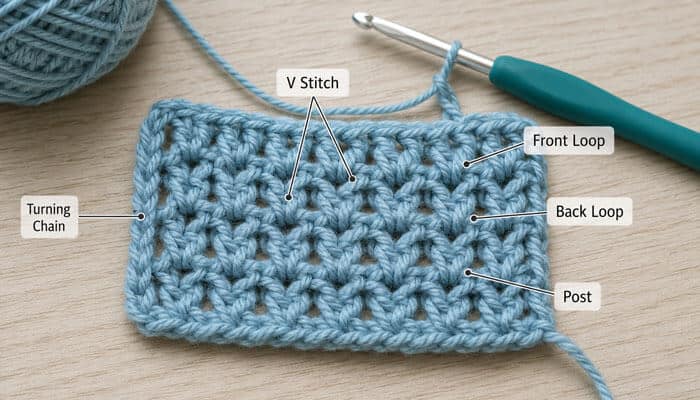
Stitch anatomy is one of the most useful parts of how to crochet for beginners step by step with pictures because it shows exactly where the hook belongs.
Recognizing the parts of a crochet stitch makes it easier to understand where the hook should be inserted. When viewed from the top, a completed stitch usually has a V shape. That V contains two loops:
- Front loop: The loop closest to you.
- Back loop: The loop farthest from you.
- Both loops: The front and back loops worked together.
- Post: The vertical body of the stitch below the top loops.
- Stitch space: A space between stitches rather than inside a stitch.
- Chain space: An opening created by one or more chain stitches.
Unless a pattern says otherwise, insert the hook under both top loops when working a standard single-crochet row.
Front Loop Only and Back Loop Only
Patterns may use the following abbreviations:
- FLO: Front loop only
- BLO: Back loop only
Working through one loop instead of both creates a visible horizontal ridge and changes the flexibility or texture of the fabric.
Right Side and Wrong Side
Some patterns identify two sides of the fabric:
- Right side (RS): The side intended to face outward.
- Wrong side (WS): The inside or less visible side.
A simple washcloth may be reversible, so the distinction may not matter. It becomes more important in garments, textured patterns, colorwork, and projects that require assembly.
Picture suggestion: Use a close-up photograph of one row and label the front loop, back loop, both loops and stitch post.
Suggested alt text: Front loop, back loop, and post of a crochet stitch.
Step 7: Make Your First Single Crochet
Single crochet turns the foundation chain into fabric and is a major milestone in how to crochet for beginners step by step with pictures.
Single crochet is a compact, beginner-friendly stitch that produces a firm fabric.
To work the first single crochet:
- Locate the second chain from the hook.
- Do not count the loop on the hook.
- Insert the hook into the second chain.
- Yarn over.
- Pull the yarn through the chain.
You should now have two loops on the hook.
- Yarn over again.
- Pull through both loops.
One loop remains on the hook, and your first single crochet is complete.
Picture 8: First Single Crochet Stitch
Photo direction: Use four images showing the hook entering the second chain, pulling up a loop, two loops on the hook, and the final pull-through.
Suggested alt text: How to make the first single crochet stitch.
Suggested caption: Insert the hook into the second chain, pull up a loop, and pull through both loops.
Step 8: Single Crochet Across the Foundation Chain
Working evenly across the chain builds confidence in how to crochet for beginners step by step with pictures.
Continue across the chain:
- Insert the hook into the next chain.
- Yarn over.
- Pull up a loop.
- Yarn over again.
- Pull through both loops.
Repeat in every remaining chain.
If you began with 21 chains and worked into the second chain from the hook, you should finish with 20 single crochet stitches.
Count the First Row
Counting the first row prevents early errors while following how to crochet for beginners step by step with pictures. Count the V shapes along the top edge of the row. Every single crochet forms one V. Place a locking stitch marker in the first and last stitch. These markers make it easier to identify the row edges.
Picture 9: Completed First Row of Single Crochet
Photo direction: Lay the first row flat. Mark the first stitch, several middle stitches and the final stitch.
Suggested alt text: Completed first row of single crochet stitches.
Suggested caption: Count the V shapes across the top to confirm the correct number of stitches.
Step 9: Make a Turning Chain
The turning chain prepares the next row and keeps how to crochet for beginners step by step with pictures organized.
At the end of the first row:
- Chain one.
- Keep the hook in the working loop.
- Turn the fabric as you would turn a page.
- Position the next row so you can work from right to left if you are right-handed, or left to right if you are left-handed.
In this single-crochet tutorial, the chain-one turning chain does not count as a stitch.
The turning chain raises the working yarn to the approximate height of the next row.
Picture 10: Chain One and Turn
Photo direction: Show the completed chain one before turning and the fabric after turning.
Suggested alt text: How to chain one and turn a crochet row.
Suggested caption: Make one turning chain and rotate the work before beginning the next row.
Step 10: Crochet the Second Row
The second row shows how to crochet for beginners step by step with pictures from a chain exercise into repeatable fabric. Insert the hook under both top loops of the first stitch. The stitch appears as a V, so the hook should pass beneath both sides of that V.
Complete a single crochet:
- Insert the hook under both loops.
- Yarn over.
- Pull up a loop.
- Yarn over.
- Pull through both loops.
Continue in every stitch across.
Count the row when you reach the end. You should still have 20 stitches.
Picture 11: Where to Insert the Hook
Photo direction: Show a close view of the top V of a stitch, with the hook inserted beneath both loops.
Suggested alt text: Where to insert the hook for single crochet.
Suggested caption: Insert the hook under both top loops unless the pattern gives different instructions.
Step 11: Continue Crocheting Rows
Repeated rows turn how to crochet for beginners step by step with pictures into a practical skill rather than a one-time exercise.
Repeat the following sequence:
- Chain one.
- Turn the work.
- Single crochet in the first stitch.
- Single crochet in every stitch across.
- Count the stitches.
- Mark the first and last stitches when necessary.
After several rows, the structure should become easier to recognize.
The top edge displays a row of V-shaped stitches. The sides should remain relatively straight when the stitch count remains consistent.
Step 12: Fasten Off the Yarn
Fastening off completes the active loop and is an essential finishing step in how to crochet for beginners step by step with pictures.
When the piece reaches the desired length:
- Complete the last stitch.
- Cut the working yarn, leaving a tail approximately 15 cm or 6 inches long.
- Yarn over using the cut end.
- Pull the entire tail through the loop on the hook.
- Remove the hook.
- Pull gently to secure the finish.
Do not make several bulky knots. A properly fastened-off loop and securely woven tail are normally sufficient.
Picture 13: How to Fasten Off Crochet
Photo direction: Show the cut yarn being pulled completely through the final loop.
Suggested alt text: How to fasten off a crochet project.
Suggested caption: Pull the cut yarn tail through the final loop to secure the project.
Step 13: Weave In the Yarn Ends
Neatly woven ends give a polished finish to projects made while learning how to crochet for beginners step by step with pictures.
Thread the yarn tail through a blunt tapestry needle.
To weave in the end:
- Insert the needle through several nearby stitches.
- Change direction and weave through another section.
- Avoid pulling hard enough to distort the fabric.
- Trim the remaining tail close to the fabric.
For slippery yarn, weave in several directions. For a reversible project, keep the tail hidden within the stitch structure rather than carrying it visibly across one side.
Picture 14: Weaving In Crochet Ends
Photo direction: Show the tapestry needle traveling through the back of several stitches.
Suggested alt text: How to weave in yarn ends after crocheting.
Suggested caption: Weave each tail through several stitches before trimming the excess yarn.
How to Join a New Ball of Yarn
Joining yarn correctly allows how to crochet for beginners step by step with pictures to continue without bulky knots or weak connections.
You may need to join another ball when the current yarn runs out. For a neat result, make the change near the end of a row when possible rather than in the middle of a highly visible section.
Joining the Same Color
- Stop before completing the final yarn over of the current stitch.
- Leave the remaining loops on the hook.
- Place the new yarn over the hook, leaving a tail long enough to weave in.
- Pull the new yarn through the remaining loops to finish the stitch.
- Continue crocheting with the new ball.
- Gently tighten both yarn tails without distorting the stitch.
- Weave in both ends securely after completing the project.
Avoid tying a large knot between the two yarn ends. A bulky knot can become visible, uncomfortable or difficult to hide.
How to Change Yarn Colors
Changing color uses almost the same method:
- Work the final stitch in the old color until the last yarn over remains.
- Yarn over with the new color.
- Pull the new color through the remaining loops.
- Make the turning chain with the new color when changing at the end of a row.
- Continue the next stitch or row with the new yarn.
- Weave in the yarn tails when the project is complete.
Changing color during the last step of the previous stitch creates a cleaner transition than completing the entire stitch in the old color.
Picture suggestion: Show the final stitch with two loops remaining, the new yarn being added and the completed color change.
Suggested alt text: Changing yarn color during the final step of a crochet stitch.
How to Pause and Resume a Crochet Project
Saving the active loop correctly helps readers continue how to crochet for beginners step by step with pictures without accidental unraveling.
Before putting the project away, enlarge the working loop slightly and place a locking stitch marker through it. This prevents the loop from pulling out while the project is stored.
To resume:
- Remove the stitch marker.
- Insert the hook through the working loop.
- Gently shorten the loop until it sits on the hook shaft.
- Confirm which side of the row you are working from.
- Check the most recent stitch count before continuing.
Store the yarn label, hook, and unfinished project together. Using a different hook size when you return can change the fabric’s appearance.
Basic Crochet Stitches Beginners Should Learn
These stitches expand on how to crochet for beginners step by step with pictures beyond the first single-crochet swatch.
After becoming comfortable with chains and single crochet, learn the following stitches.
| Stitch | U.S. abbreviation | Basic action | Fabric result |
| Chain | ch | Yarn over and pull through the loop | Creates a foundation or open space |
| Slip stitch | sl st | Insert hook, yarn over, and pull through the stitch and working loop | Very short joining or traveling stitch |
| Single crochet | sc | Insert, pull up loop, yarn over, and pull through two loops | Dense and firm fabric |
| Half double crochet | hdc | Yarn over, insert, pull up loop, yarn over, and pull through three loops | Medium-height fabric |
| Double crochet | dc | Yarn over, insert, pull up loop, pull through two loops twice | Taller, softer, and more open fabric |
| Treble crochet | tr | Yarn over twice, insert, pull up loop, pull through two loops three times | Tall and open fabric |
How to Make a Slip Stitch
A slip stitch is commonly used to join rounds, move across stitches or finish an edge.
- Insert the hook into the next stitch.
- Yarn over.
- Pull the yarn through the stitch and the loop on the hook in one movement.
The slip stitch adds very little height.
How to Make a Half Double Crochet
- Yarn over.
- Insert the hook into the next stitch.
- Yarn over and pull up a loop.
- You should have three loops on the hook.
- Yarn over.
- Pull through all three loops.
Half double crochet is taller than single crochet but shorter than double crochet.
How to Make a Double Crochet
- Yarn over.
- Insert the hook into the next stitch.
- Yarn over and pull up a loop.
- You should have three loops on the hook.
- Yarn over and pull through two loops.
- Yarn over again.
- Pull through the remaining two loops.
Double crochet creates taller stitches and generally produces fabric more quickly than single crochet.
Crochet Increases and Decreases for Beginners
Shaping techniques are the next stage of how to crochet for beginners step by step with pictures after straight rows become comfortable.
Increases and decreases change the number of stitches in a row or round. They are used to shape hats, bags, toys, garments, and decorative motifs.
How to Make a Single-Crochet Increase
A single-crochet increase is made by placing two single crochet stitches into the same stitch.
- Work one single crochet into the next stitch.
- Insert the hook into the same stitch again.
- Work a second single crochet.
- Two stitches have now been created from one stitch.
An increase may be written as:
- 2 sc in next st
- sc inc
- inc
Always check the pattern’s abbreviation key.
How to Make a Single-Crochet Decrease
A single-crochet decrease combines two stitches into one. It is often abbreviated as sc2tog.
- Insert the hook into the next stitch.
- Yarn over and pull up a loop.
- Insert the hook into the following stitch.
- Yarn over and pull up another loop.
- You should have three loops on the hook.
- Yarn over.
- Pull through all three loops.
The stitch count decreases by one.
Why Stitch Counts Matter During Shaping
Count the row or round after every group of increases or decreases. Missing one shaping instruction can change the size, symmetry, and fit of the finished project.
Crocheting in Rows vs. Crocheting in Rounds
Understanding construction methods helps readers apply how to crochet for beginners step by step, with pictures to flat and circular projects.
The washcloth in this guide is worked in rows, but many crochet projects are worked in rounds.
| Construction method | How it works | Common projects |
| Rows | The fabric is turned at the end of each row | Scarves, washcloths, blankets, and garment panels |
| Joined rounds | Each round is joined to its beginning, often with a slip stitch | Hats, granny squares, and circular motifs |
| Continuous rounds | Crocheting continues in a spiral without joining each round | Amigurumi, baskets, and some hats |
Starting With a Chain Ring
A pattern may ask you to:
- Make several chains.
- Join the first and last chain with a slip stitch.
- Work the next stitches into the center of the ring.
Take care not to twist the chain before joining it.
Starting With a Magic Ring
A magic ring, also called an adjustable ring, creates a center that can be tightened after the first round.
- Form a loop with the yarn.
- Insert the hook through the loop.
- Yarn over and pull up a loop.
- Make the required starting chain.
- Crochet the first-round stitches into the ring.
- Pull the yarn tail to close the center.
A magic ring is useful for hats, circular motifs, and amigurumi because it can reduce the opening at the center.
Mark the first stitch when working in continuous rounds. Without a marker, it can be difficult to see where one round ends and the next begins.
U.S. and U.K. Crochet Terminology
Terminology differences are important in how to crochet for beginners step by step with pictures because the same abbreviation can describe different stitches.
One of the most important beginner lessons is that U.S. and U.K. patterns may use the same abbreviations for different stitches.
| U.S. term | U.S. abbreviation | Equivalent U.K. term |
| Chain | ch | Chain |
| Slip stitch | sl st | Slip stitch |
| Single crochet | sc | Double crochet |
| Half double crochet | hdc | Half treble crochet |
| Double crochet | dc | Treble crochet |
| Treble crochet | tr | Double treble crochet |
A pattern that includes “single crochet” usually uses U.S. terminology because the U.K. system does not use that stitch name.
Check the pattern introduction, spelling, yarn measurements, and stitch definitions before beginning.
Understanding Crochet Tension
Balanced tension is one of the main skills developed through how to crochet for beginners step by step with pictures.
Tension describes how tightly or loosely you hold and work the yarn.
Signs Your Tension Is Too Tight
- The hook is difficult to insert.
- Yarn squeaks or drags against the hook.
- Your hands become tired quickly.
- Stitches look compressed.
- The foundation chain pulls inward.
- The finished fabric feels stiff.
Signs Your Tension Is Too Loose
- Loops fall from the hook.
- Stitches have large gaps.
- The fabric appears unstable.
- The working loop becomes unusually long.
- The project is larger than expected.
How to Improve Crochet Tension
- Hold the hook gently.
- Keep the working loop on the shaft rather than the narrow throat.
- Allow the yarn to slide through your fingers.
- Practice the same stitch repeatedly.
- Pause when your hands become tense.
- Try a different hook material or handle.
- Make a practice swatch before starting a fitted project.
Consistent tension is more important than making extremely tight stitches.
What Is Crochet Gauge?
Gauge connects stitch size to finished measurements and extends how to crochet for beginners step by step with pictures into fitted projects.
Gauge measures how many stitches and rows fit within a specified area, commonly 4 inches or 10 cm.
A pattern may state:
14 single crochet stitches and 16 rows = 4 inches using a 5.5 mm hook.
Your personal stitch size may differ from the designer’s stitch size even when you use the same yarn and hook.
How to Check Gauge
- Use the yarn, hook, and stitch named in the pattern.
- Crochet a swatch larger than the measurement area.
- Lay it flat without stretching.
- Measure across the center.
- Count the stitches and rows within 4 inches or 10 cm.
- Compare the count with the pattern gauge.
How to Correct Gauge
| Gauge result | Meaning | Adjustment |
| Too many stitches in 4 inches | Your stitches are too small | Try a larger hook |
| Too few stitches in 4 inches | Your stitches are too large | Try a smaller hook |
| Correct stitch count but wrong row count | Your stitch height differs | Adjust how high you pull loops or follow pattern measurements |
| Fabric is stiff | The hook may be too small or the tension too tight | Try a larger hook |
| Fabric is too open | The hook may be too large or the tension too loose | Try a smaller hook |
Gauge is not critical for a practice square or a simple washcloth. It becomes important for garments, fitted hats, bags, matched pieces, and projects with limited yarn.
How to Read a Beginner Crochet Pattern
Pattern reading helps learners move from how to crochet for beginners step by step with pictures to independent project work.
Crochet patterns use abbreviations to save space.
A simple pattern might say:
Ch 21. Sc in 2nd ch from hook and in each ch across. Ch 1, turn. Sc in each st across. Repeat last row until piece measures 8 inches. Fasten off.
Written in full, this means:
- Make 21 chain stitches.
- Work one single crochet into the second chain from the hook.
- Work one single crochet in every remaining chain.
- Make one chain stitch.
- Turn the work.
- Work one single crochet in every stitch.
- Repeat that row until the piece measures 8 inches.
- Cut and secure the yarn.
Common Crochet Abbreviations
| Abbreviation | Meaning |
| beg | Beginning |
| ch | Chain |
| dc | Double crochet |
| hdc | Half double crochet |
| lp | Loop |
| rem | Remaining |
| rep | Repeat |
| rnd | Round |
| sc | Single crochet |
| sk | Skip |
| sl st | Slip stitch |
| sp | Space |
| st or sts | Stitch or stitches |
| tog | Together |
| yo | Yarn over |
Common Crochet Pattern Symbols
- Asterisks (*) usually show instructions that must be repeated.
- Parentheses ( ) may group stitches worked into one location or provide different size instructions.
- Brackets [ ] commonly group a repeated instruction.
- Colon (:) may introduce a stitch sequence or row instruction.
- Numbers at the end of a row often state the expected stitch count.
Always read the pattern notes before beginning because designers may define special abbreviations differently.
How to Choose a Beginner-Friendly Crochet Pattern
Selecting a suitable pattern keeps how to crochet for beginners step by step with pictures encouraging rather than unnecessarily difficult.
A pattern described as “easy” is not always suitable for someone making their first project. Review the entire pattern before buying yarn or beginning the foundation chain.
Look for a pattern that includes:
- A basic or beginner skill rating
- U.S. or U.K. terminology clearly stated
- A complete materials list
- Yarn weight and yardage
- Metric crochet-hook size
- Finished measurements
- Gauge information
- Clearly defined abbreviations
- Stitch counts at the ends of rows
- Close-up photographs or diagrams
- Limited shaping
- One or two basic stitches
- Minimal color changes
- Instructions for fastening off and finishing
Avoid choosing a first pattern based only on the finished photograph. A simple-looking project may include seaming, shaping, post stitches, multiple colors or advanced construction.
Questions to Ask Before Starting
- Do I know every stitch listed?
- Does the pattern use U.S. or U.K. terminology?
- Do I have enough yarn?
- Is gauge important?
- Is the item worked in rows or rounds?
- Does the turning chain count as a stitch?
- Are there increases or decreases?
- Will different pieces need to be joined?
- Can I identify the expected stitch count?
Reading the complete pattern before starting can reveal unfamiliar techniques early enough to practice them separately.
What Should Your First Crochet Project Look Like?
A successful first crochet project is not necessarily beautiful or perfectly shaped.
Instead, it should help you practice:
- Consistent stitch counts
- Turning rows
- Yarn tension
- Stitch recognition
- Finishing techniques
The best beginner projects prioritize skill-building over appearance.
Many experienced crocheters still keep their first washcloth, coaster, or practice square as a reminder of how far they have progressed.
First Crochet Project: Easy Single-Crochet Washcloth
This washcloth puts how to crochet for beginners step by step with pictures into practice through one useful and manageable project.
This project uses only chains, single crochet, turning and fastening off. Cotton yarn is recommended because it is absorbent, but smooth acrylic yarn can be used for a practice square.
Project Snapshot
| Detail | Guide |
| Difficulty | Absolute beginner |
| Construction | Flat rows |
| Main stitch | U.S. single crochet |
| Starting chain | 26 chains |
| Stitch count | 25 single crochet stitches per row |
| Approximate finished size | 8 inches square |
| Estimated yarn | One ball of medium-weight cotton; confirm yardage on the label |
| Gauge | Not critical, provided the fabric is square and comfortable |
Skill Level
Absolute beginner
Materials
- One ball of number 4 medium-weight cotton yarn
- 5.5 mm crochet hook, or size appropriate for the yarn
- Scissors
- Tapestry needle
- Two locking stitch markers
- Measuring tape
Finished Size
Approximately 8 inches square, although the final measurement will depend on your yarn, hook and tension.
Abbreviations
- ch: Chain
- sc: Single crochet
- st: Stitch
- rep: Repeat
Important Pattern Note
The chain-one turning chain does not count as a stitch in this project.
Washcloth Instructions
Foundation chain: Ch 26.
Row 1: Sc in the second ch from the hook. Sc in each remaining ch across. You should have 25 sc.
Row 2: Ch 1 and turn. Sc in the first st and each st across. Count 25 sc.
Visual checkpoint: The top edge should show 25 clear V shapes. Place a marker in the first and last stitch before continuing.
Following rows: Rep Row 2 until the piece is approximately square or reaches the desired length. Count each row and measure the piece without stretching it.
Finish: Cut the yarn, leaving a 6-inch tail. Pull the tail through the final loop and weave in both ends.
Optional Single-Crochet Border
A border can make the edges look more finished.
- Do not fasten off after the last row.
- Chain one.
- Work single crochet stitches evenly along each side.
- Place three single crochet stitches in each corner.
- Join to the first border stitch with a slip stitch.
- Fasten off and weave in the tail.
Do not overcrowd the side edges. Too many stitches can make the border ripple, while too few may make the project curl inward.
Finished Beginner Crochet Washcloth
Photo direction: Photograph the completed washcloth flat beside the crochet hook and yarn. Include one close-up showing the stitch texture.
Suggested alt text: Finished single crochet washcloth for beginners.
Suggested caption: This beginner washcloth is made with foundation chains and repeated single crochet rows.
How to Block a Crochet Project
Blocking improves the final shape of an item completed through how to crochet for beginners step by step with pictures. Blocking is the process of gently shaping finished crochet fabric so that the edges, measurements, and stitch pattern appear more even.
Blocking can help:
- Straighten uneven edges
- Open lace or textured stitches
- Bring a project closer to its intended measurements
- Flatten curling sections
- Prepare separate pieces for seaming
- Improve the finished appearance
Basic Blocking Process
- Read the yarn’s care label.
- Weave in the yarn ends unless the pattern instructs otherwise.
- Choose a blocking method appropriate for the fiber.
- Shape the project on a clean, suitable surface.
- Measure the width and length.
- Pin the edges when necessary without overstretching them.
- Allow the project to dry or cool completely before removing it.
Common methods include wet blocking, spray blocking and steam blocking. Not every method is appropriate for every fiber.
Use particular care with heat. Acrylic and other synthetic yarns can be permanently changed or damaged by excessive heat. Keep hot tools away from the fabric unless you understand the yarn’s heat tolerance and the technique being used.
A simple cotton washcloth can often be washed, gently shaped and laid flat to dry.
Picture suggestion: Show the washcloth measured and shaped flat on a blocking surface.
Suggested alt text: Beginner crochet washcloth shaped flat during blocking.
Why Do Crochet Edges Become Uneven?
Uneven edges usually result from changing the stitch count.
You May Be Losing Stitches When:
- The fabric becomes narrower.
- One edge slopes inward.
- You forgot to crochet into the first stitch.
- You miss the last stitch because it resembles the turning chain.
You May Be Adding Stitches When:
- The fabric becomes wider.
- The edges flare outward.
- You work into the turning chain when it does not count as a stitch.
- You crochet twice into the first or last stitch.
How to Keep Crochet Edges Straight
- Count every row.
- Place a marker in the first and last stitch.
- Learn whether the turning chain counts as a stitch.
- Look for every V along the top edge.
- Stop and correct the row as soon as the count changes.
10 Beginner Crochet Mistakes to Avoid
Every crocheter makes mistakes while learning. Understanding the most common problems can help you progress faster and avoid unnecessary frustration.
Pulling Every Stitch Too Tight
Tight stitches make it difficult to insert the hook and can cause hand fatigue.
Ignoring Stitch Counts
Even experienced crocheters count their stitches regularly.
Choosing Dark Yarn First
Dark yarn makes loops difficult to see and identify.
Using Fuzzy Yarn Too Early
Textured yarn hides stitch structure and complicates learning.
Skipping Practice Swatches
Small practice pieces help build confidence before starting larger projects.
Forgetting Stitch Markers
Markers make it much easier to identify row beginnings and endings.
Holding the Hook Too Tightly
A relaxed grip generally produces smoother movement and better tension.
Learning Too Many Stitches at Once
Master chains and single crochet before moving to more advanced techniques.
Comparing Your Work to Experienced Crocheters
Every crocheter started with uneven stitches and imperfect rows.
Avoiding Mistakes Instead of Fixing Them
Learning how to undo and correct stitches is an important crochet skill.
Progress comes from repetition, not perfection.
Common Beginner Crochet Mistakes and Fixes
This troubleshooting guide makes how to crochet for beginners step by step with pictures more useful when stitches, edges or tension go wrong.
| Problem | Likely cause | How to fix it |
| Hook will not enter the foundation chain | Chains are too tight | Remake the chain loosely or use a larger hook for the chain |
| Fabric becomes narrower | Stitches are being skipped | Mark and count the first and last stitches |
| Fabric becomes wider | Extra stitches are being added | Check whether the turning chain counts as a stitch |
| Project curls | Tight foundation, uneven tension or normal new-fabric curl | Loosen tension, use a larger hook or continue several rows |
| Yarn splits | Hook enters between yarn plies | Insert carefully and try a smoother hook |
| Loops fall off the hook | The working loop is too loose | Shorten the loop and control the yarn gently |
| Hands become sore | Hook is gripped too tightly | Relax, take breaks and try an ergonomic hook |
| Rows look different sizes | Tension changes between sessions | Make a short practice swatch before resuming |
| Stitch count is correct, but edges look bumpy | The turning method varies | Turn the work in the same direction each row |
| Yarn tail comes loose | The end was not woven securely | Weave through several stitches and change direction |
| Foundation chain twists | The chain rotated before the first row | Lay the chain flat and keep the V shapes facing the same direction |
| Accidental holes appear | A stitch was skipped, or the hook entered a space | Count the row and work into the top V of each stitch |
| Fabric changes after a break | A different hook or a tighter grip was used | Store the hook with the project and relax before resuming |
How to Undo Crochet Stitches
Removing crochet stitches is often called frogging.
To undo a stitch:
- Remove the hook from the working loop.
- Pull the working yarn gently.
- Allow one stitch at a time to unravel.
- Stop when you reach the stitch before the mistake.
- Reinsert the hook into the working loop.
- Confirm the stitch count before continuing.
Place a stitch marker in the working loop before putting a project away. This prevents accidental unraveling.
How to Find the First and Last Stitch
The first and final stitches are easy to miss because the turning chain and edge loops can look similar.
To identify a stitch:
- Look for the V on the top edge.
- Follow the V down to its vertical stitch body.
- Insert the hook under the loops indicated by the pattern.
- Use stitch markers until the edge structure becomes familiar.
Marking edge stitches is one of the simplest ways to prevent changing stitch counts.
Does the Turning Chain Count as a Stitch?
The answer depends on the stitch and pattern. A chain-one turning chain used for single crochet often does not count as a stitch. Taller turning chains may count as the first stitch, but designers sometimes use alternative instructions.
Never assume. Check the pattern notes and row-end stitch counts. For the washcloth pattern in this guide, the chain-one turning chain does not count as a stitch.
Turning-Chain Quick Reference
The number of turning chains usually depends on the height of the next row’s stitch.
| Crochet stitch | Common turning chain | Usually counts as a stitch? | Typical first insertion point |
| Slip stitch | 0 | Not applicable | First stitch |
| Single crochet | Chain 1 | No | First stitch |
| Half double crochet | Chain 2 | Often no | First stitch |
| Double crochet | Chain 3 | Often yes | Next stitch |
| Treble crochet | Chain 4 | Often yes | Next stitch |
These are common conventions, not universal rules. Some designers use a shorter turning chain or state that a taller turning chain does not count as a stitch.
Always follow the instructions and expected stitch count in the pattern you are using.
Right-Handed and Left-Handed Crochet
The stitch structure is the same for both right- and left-handed crocheters. The working direction is mirrored.
- Right-handed crocheters usually move across a row from right to left.
- Left-handed crocheters usually move from left to right.
Left-handed learners may find mirrored photographs or videos easier to follow. Avoid forcing yourself to crochet with the opposite hand simply because a tutorial demonstrates that hand.
Crochet Practice Plan for Absolute Beginners
A structured practice schedule turns how to crochet for beginners step by step with pictures into steady daily progress.
Use this seven-day schedule to build skill without trying to learn everything at once.
| Day | Practice goal | Suggested time |
| Day 1 | Make and remove slip knots | 10–15 minutes |
| Day 2 | Practice chains and counting | 15–20 minutes |
| Day 3 | Make the first single-crochet row | 20 minutes |
| Day 4 | Practice turning and second rows | 20–30 minutes |
| Day 5 | Create a small square with straight edges | 30 minutes |
| Day 6 | Practice fastening off and weaving ends | 20 minutes |
| Day 7 | Begin the washcloth project | 30–45 minutes |
Stop when your hands become tired. Several short practice sessions are often more productive than one long, uncomfortable session.
Best First Crochet Projects
These project ideas provide a natural next step after mastering how to crochet for beginners step by step with pictures.
After completing a washcloth, choose projects that use flat shapes and repeated stitches.
Good Beginner Projects
- Coaster
- Mug rug
- Dishcloth
- Washcloth
- Simple scarf
- Headband
- Cowl
- Small rectangular bag
- Basic granny square
- Simple baby blanket
Projects to Save for Later
- Fitted sweaters
- Socks
- Complex lace
- Detailed amigurumi
- Large garments require a precise gauge
- Projects with many color changes
- Patterns with extensive shaping
- Very dark or fuzzy yarn projects
A successful small project builds confidence more effectively than an ambitious project that is difficult to finish.
How Long Does It Take to Learn Crochet?
Many beginners can understand the slip knot, chain, and single crochet during their first few practice sessions. Developing smooth movement and consistent tension may take longer.
Your progress depends on:
- Practice frequency
- Hand coordination
- Yarn and hook choice
- Quality of the instructions
- Complexity of the project
- Willingness to undo and correct mistakes
The goal is not speed. Learn to recognize stitch structure and maintain the correct count before trying to crochet faster.
How to Crochet More Comfortably
Crochet should not require painful gripping or prolonged awkward posture.
Use these habits:
- Sit with your back supported.
- Keep your shoulders relaxed.
- Rest your forearms when possible.
- Avoid bending your wrists sharply.
- Hold the hook with gentle pressure.
- Take regular hand and eye breaks.
- Stretch your fingers carefully.
- Work in good lighting.
- Stop when you experience persistent pain, numbness or tingling.
An ergonomic hook may improve comfort, but technique, posture and rest remain important.
How to Care for Crochet Projects
Read the yarn label before washing the finished item. Fiber type determines whether the project can be machine washed, hand washed, tumble dried or laid flat.
General care steps include:
- Save the yarn label until the project is complete.
- Follow the washing temperature and drying symbols.
- Wash delicate handmade items in a mesh laundry bag when appropriate.
- Avoid hanging heavy wet crochet pieces because they may stretch.
- Reshape the item after washing.
- Lay flat to dry when required.
- Store clean projects away from moisture and direct sunlight.
Create a small care label when giving a crochet item as a gift.
Fastest Ways to Improve Crochet Skills
The quickest improvement usually comes from deliberate practice rather than attempting increasingly difficult projects.
Crochet Frequently
Ten to fifteen minutes daily is often more effective than a single long weekly session.
Count Every Row
Accurate stitch counts prevent many beginner mistakes.
Practice With Light-Colored Yarn
Visible stitches make learning easier.
Review Finished Rows
Study completed stitches to understand their structure.
Learn to Recognize Mistakes
Identifying errors early makes them easier to correct.
Repeat Basic Stitches
Strong fundamentals accelerate long-term progress.
Consistent practice almost always produces faster improvement than constantly switching between new techniques.
What to Learn After Your First Crochet Project
This progression shows where to go after how to crochet for beginners step by step with pictures has helped you finish the first project.
After completing the beginner washcloth, continue developing your skills in a logical order:
- Practice half double crochet.
- Practice double crochet.
- Learn front-loop-only and back-loop-only stitches.
- Make even increases and decreases.
- Join a new ball of yarn.
- Change colors at the end of a row.
- Crochet in joined rounds.
- Crochet in continuous rounds.
- Learn the magic-ring technique.
- Read a simple crochet stitch chart.
- Make a granny square.
- Join crochet pieces with a yarn needle or slip-stitch seam.
- Check the gauge for a sized project.
A progressive learning plan prevents beginners from trying too many unfamiliar techniques in one project.
After following how to crochet for beginners step by step with pictures, your next goal should be recognizing stitches without relying on every photograph. That skill will make written patterns, charts, and more advanced projects much easier to understand.
Editorial Methodology
This tutorial was created using established crochet fundamentals, beginner teaching methods, stitch-construction principles, yarn-selection best practices, and practical crochet techniques commonly used by crochet instructors and experienced makers.
The instructions focus on helping complete beginners develop confidence, understand stitch structure, and build a foundation for future crochet projects.
Final Thoughts
Learning how to crochet for beginners step by step with pictures becomes manageable when you focus on one movement at a time. Start with a comfortable grip, make loose chains, learn where to insert the hook, and count every stitch before turning the next row.
Your first square does not need perfectly straight edges or identical stitches. Completing it teaches you how yarn tension, hook movement, and stitch placement work together. Once you can finish the washcloth, you have the foundation needed for scarves, granny squares, blankets, bags, and simple projects worked in rounds.
Keep the first swatch, record the yarn and hook you used, and compare it with your next project. Visible improvement is one of the best reasons to continue practicing.
How to Crochet for Beginners Step by Step with Pictures FAQs
1. What is the easiest way to learn how to crochet for beginners step by step with pictures?
The easiest way is to start with a slip knot, make a foundation chain, practice single crochet, turn rows, count stitches, and use clear pictures to follow each hand movement.
2. What supplies do I need for how to crochet for beginners step by step with pictures?
You need medium-weight yarn, a crochet hook, scissors, a yarn needle, stitch markers, and a measuring tape. Smooth, light-colored yarn is best for beginners.
3. What is the best first stitch for beginner crochet learners?
Single crochet is the best first stitch because it is simple, firm, and helps beginners learn hook placement, yarn over, pulling loops, and row counting.
4. Why are pictures important when learning crochet step by step?
Pictures help beginners see where to insert the hook, how loops should look, how to count stitches, and how each crochet step creates fabric.
5. What is the best first project for beginners learning crochet?
A single-crochet washcloth is the best first project because it uses basic chains, repeated rows, turning, fastening off, and weaving in yarn ends.
6. How many days does it take to learn crochet?
Most beginners can learn basic stitches within a few days, while developing consistent tension and confidence usually takes several weeks of practice.
7. What is the easiest crochet project for beginners?
A washcloth, coaster, or small scarf made with single crochet stitches is often the easiest first project.
8. What size crochet hook should a beginner use?
A 5 mm to 5.5 mm hook paired with medium-weight yarn is a common beginner-friendly choice.
9. Why are my crochet edges uneven?
Uneven edges usually result from accidentally adding or skipping stitches.
10. Can I teach myself crochet?
Yes. Many people successfully learn crochet through written tutorials, photographs, diagrams, books, and video instruction.

Source: Cosmo Politian