




Which Resource Management Task Deploys or Activates Personnel and Resources? Under the National Incident Management System, the correct answer is Mobilize. This task begins after the required personnel, teams, equipment, supplies, or facilities have been identified, requested, and officially authorized to respond through established channels.
The answer to which resource management task deploys or activates personnel and resources becomes clearer when deployment and activation are distinguished. Mobile resources—such as response teams, vehicles, equipment, and supplies—are deployed to the incident, while fixed resources—including emergency operations centers, hospitals, laboratories, and shelters—are activated. Mobilize is the third of the six NIMS resource management tasks and connects resource acquisition with incident tracking and assignment.
Key Takeaways
- Mobilize is the NIMS resource management task that deploys personnel and mobile resources or activates fixed facilities.
- Mobilize is the third of the six NIMS resource management tasks.
- It follows Identify Requirements and Order and Acquire.
- Resources should respond only after being officially requested and dispatched through established channels.
- Mobile resources are deployed, while fixed facilities such as hospitals, shelters, laboratories, and emergency operations centers are activated.
- Incident managers track individual resources from mobilization through demobilization.
- All personnel, teams, and equipment arriving at an incident must complete the formal check-in process.
What Is NIMS?
The National Incident Management System, commonly known as NIMS, is a nationwide framework that helps government agencies, nongovernmental organizations, private-sector partners, and community organizations coordinate before, during, and after emergencies.
NIMS provides standardized terminology, procedures, and systems for incident command, communications, resource management, and multiagency coordination. Its purpose is to help organizations work together efficiently, even when responders come from different jurisdictions or agencies.
The framework can be applied to incidents of any size, cause, or complexity, including:
- Natural disasters
- Fires and hazardous-material incidents
- Public-health emergencies
- Terrorist attacks
- Planned public events
- Transportation emergencies
- Multijurisdictional incidents
- Routine local emergencies
The question “Which resource management task deploys or activates personnel and resources?” relates directly to the NIMS incident resource-management process. Within that process, Mobilize is the third task and is responsible for preparing, deploying, or activating authorized resources.
What Is the Correct Resource Management Task?
The correct resource management task is Mobilize. Under NIMS, mobilization begins when the requesting jurisdiction or an authorized intermediary officially notifies personnel and resource providers to prepare for deployment or activation.
For example, a state Emergency Management Assistance Compact coordinator may notify an agency that another jurisdiction has requested its assistance. After the request is authorized, personnel may receive reporting instructions, prepare equipment, assemble at a designated location, arrange transportation, and begin traveling to the incident.
The answer to “Which resource management task deploys or activates personnel and resources?” is not Identify Requirements, Order and Acquire, or Track and Report. Identify Requirements determines what is needed, Order and Acquire obtains the resource, and Track and Report monitors its location and status. Mobilize is the task that prepares and sends mobile resources or activates fixed facilities.
What Does Mobilize Mean in NIMS?
In NIMS resource management, Mobilize means preparing and delivering requested personnel, teams, equipment, supplies, or other resources to an incident. For fixed resources that cannot be physically moved—such as hospitals, shelters, laboratories, and emergency operations centers—mobilization occurs through activation.
The Mobilize task may include:
- Conducting incident-specific deployment planning
- Confirming personnel qualifications and availability
- Equipping response teams
- Providing just-in-time training or safety briefings
- Establishing assembly or reporting locations
- Arranging transportation
- Communicating deployment and reporting instructions
- Moving resources according to incident priorities
- Activating fixed facilities
- Formally checking in resources upon arrival
Mobilization is more than instructing responders to travel to an emergency. It is a coordinated process designed to ensure that authorized resources reach the correct location safely, properly equipped, and ready for assignment. It also supports accountability by connecting deployment instructions, transportation, check-in, resource tracking, and incident supervision.
Why Mobilize Is the Correct Answer
The wording of the question provides two important clues:
- Deploys personnel and mobile resources
- Activates fixed facilities
Both actions occur during the Mobilize task.
Personnel, response teams, vehicles, equipment, and supplies can be physically deployed to an incident. Fixed facilities—such as hospitals, shelters, laboratories, and emergency operations centers—remain in place, so they are activated rather than transported.
This distinction separates Mobilize from the other NIMS resource management tasks. Identify Requirements determines what resources are needed, Order and Acquire secures them, and Track and Report monitors their location and status.
Therefore, the answer to “Which resource management task deploys or activates personnel and resources?” is Mobilize.
The Six NIMS Resource Management Tasks
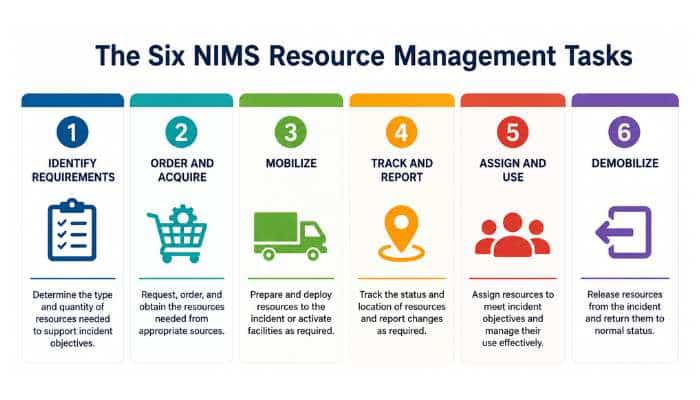
NIMS organizes incident resource management into six tasks. Although these tasks follow a logical sequence, different resources may be at different stages at the same time. For anyone asking “Which resource management task deploys or activates personnel and resources?”, Mobilize is Task 3.
| Task | Main purpose |
|---|---|
| 1. Identify Requirements | Determine which resources are needed. |
| 2. Order and Acquire | Request or obtain the required resources. |
| 3. Mobilize | Prepare, deploy, or activate authorized resources. |
| 4. Track and Report | Monitor resource location, assignment, and status. |
| 5. Demobilize | Release and return resources safely. |
| 6. Reimburse and Restock | Document costs and restore used resources. |
The answer to “Which resource management task deploys or activates personnel and resources?” is Mobilize because this is the stage when mobile resources are sent to the incident and fixed facilities are activated.
How the Mobilization Process Works
Mobilization follows an authorized resource request and moves personnel, equipment, teams, supplies, or facilities into operational readiness.
1. The Resource Need Is Confirmed
Incident personnel identify the required resource, capability, quantity, reporting location, arrival time, and expected assignment.
2. The Resource Is Requested and Approved
Authorized personnel submit the request through established channels. The providing organization confirms that the requested resource is available and capable of meeting the incident’s needs.
3. Mobilization Instructions Are Issued
Personnel receive official information about departure times, transportation, reporting locations, assignments, supervisors, and resource-order numbers. Responders should never deploy based only on news reports, social media, or informal messages.
4. Resources Are Prepared
Preparation may include:
- Confirming personnel qualifications
- Inspecting equipment
- Packaging supplies
- Issuing protective equipment
- Conducting safety briefings
- Arranging transportation
5. Resources Deploy or Activate
Mobile personnel, teams, equipment, and supplies travel to the designated location. Fixed facilities, such as hospitals, shelters, laboratories, and emergency operations centers, are activated.
6. Resources Check In and Receive Assignments
Arriving resources formally check in before receiving an assignment or moving to a staging area. Check-in supports accountability, safety, tracking, cost documentation, and incident supervision.
This process explains which resource management task deploys or activates personnel and resources and how authorized resources move from an approved request to an operational assignment.
What Should a Mobilization Procedure Include?
A mobilization procedure should explain who can authorize deployment, how personnel will be notified, and what responders must do before leaving for an incident.
It should cover:
- Authorized call-out and notification methods
- Backup communication procedures
- Personnel qualifications and required credentials
- Equipment, supplies, and protective gear
- Assembly points and transportation arrangements
- Departure, arrival, and reporting instructions
- Resource-order and cost information
- Check-in and self-dispatching rules
Clear procedures, checklists, and backup communication plans help personnel prepare quickly, especially when severe weather or infrastructure failures disrupt normal systems.
Information Provided to Deploying Personnel
Before deployment, personnel should receive clear instructions, including:
- Departure date, time, and location
- Transportation arrangements
- Estimated arrival time
- Reporting location and contact
- Expected assignment and deployment duration
- Incident and resource-order numbers
- Applicable cost or funding codes
This information helps personnel arrive at the correct location properly equipped, documented, and ready for assignment.
Deployment vs. Activation
Deployment and activation are related parts of the Mobilize task, but they apply to different types of resources.
Deployment applies to mobile resources that travel to an incident, such as:
- Emergency personnel
- Response teams
- Vehicles and equipment
- Medical supplies
- Food, water, and generators
Activation applies to fixed facilities that remain in place but begin supporting the response, including:
- Emergency operations centers
- Hospitals
- Shelters
- Laboratories
- Communications centers
For example, an ambulance is deployed, while a hospital’s emergency operations are activated. This distinction explains why Mobilize is the answer to “Which resource management task deploys or activates personnel and resources?”
Mobilize vs. Order and Acquire
A common mistake is choosing Order and Acquire instead of Mobilize. The difference is simple:
| Order and Acquire | Mobilize |
|---|---|
| Requests or obtains the resource | Prepares and deploys or activates it |
| Uses contracts, mutual aid, or agency inventories | Issues instructions and arranges movement |
| Occurs before the resource responds | Begins after authorized notification |
Order and Acquire answers: How will the resource be obtained?
Mobilize answers: How will the approved resource be deployed or activated?
Therefore, when asked “Which resource management task deploys or activates personnel and resources?”, the correct answer is Mobilize.
Who Authorizes Resource Mobilization?
Resource mobilization begins only after personnel, teams, equipment, supplies, or facilities have been officially requested and the providing organization receives authorized notification.
The request may be approved by the Incident Commander or personnel with delegated ordering authority. Notification can come directly from the requesting jurisdiction or through an authorized mutual-aid or emergency-management coordinator.
A single-point ordering system helps prevent duplicate requests, improve accountability, and maintain accurate records of resource orders and costs.
Therefore, when determining which resource management task deploys or activates personnel and resources, remember that Mobilize begins only after the requested resource is confirmed, authorized, and given official deployment or activation instructions.
Mobilize Task vs. the Dispatch/Deployment NIMS Characteristic
Although Mobilize and Dispatch/Deployment are related, they refer to different parts of NIMS.
| Concept | What it means |
|---|---|
| Mobilize | One of the six NIMS resource management tasks. It prepares and deploys mobile resources or activates fixed facilities after authorized notification. |
| Dispatch/Deployment | A NIMS Management Characteristic requiring resources to respond only after they have been officially requested and dispatched through established procedures. |
The key difference is that Mobilize describes the resource-management task, while Dispatch/Deployment describes the rule that prevents unauthorized or self-dispatched response.
Therefore, when asked “Which resource management task deploys or activates personnel and resources?”, the correct answer is Mobilize.
How Resource Tracking Connects to Mobilization
Resource tracking begins when personnel, teams, equipment, or supplies enter the mobilization process and continues until they are demobilized.
Tracking helps incident managers monitor:
- Resources that have been ordered
- Expected arrival times
- Check-in status
- Current location and assignment
- Operational condition
- Whether resources are assigned, available, or out of service
- Release and demobilization status
Tracking supports accountability, safety, coordination, and informed resource decisions. However, Track and Report only monitors resources; it does not deploy or activate them. Therefore, the answer to “Which resource management task deploys or activates personnel and resources?” remains Mobilize.
Why Self-Dispatching Is Not Allowed
Self-dispatching occurs when personnel or resources respond without an official request or authorization. This can create safety, accountability, traffic, credentialing, assignment, and cost-recovery problems.
Under NIMS, resources should respond only after being requested and dispatched through established procedures. Unrequested responders may be directed to a staging or mobilization area for evaluation, check-in, assignment, or release.
Examples of Resource Mobilization
These examples show how the Mobilize task works in different emergency situations.
Wildfire Response
A wildfire exceeds local response capacity, so additional engines, hand crews, water tenders, and medical teams are requested through mutual-aid channels.
After receiving authorized notification, the assisting agencies prepare personnel and equipment, confirm reporting instructions, travel to the designated location, and complete check-in. These actions are part of the Mobilize task.
Hurricane Shelter Activation
Before a hurricane, officials open a school as an emergency shelter. Shelter staff, medical personnel, security teams, food, cots, and supplies are requested.
Personnel and supplies are deployed, while the school facility is activated. This example shows how Mobilize covers both mobile resources and fixed facilities.
Mass-Casualty Medical Response
A mass-casualty incident requires additional ambulances, medical personnel, and hospital capacity.
Ambulances and response teams are deployed to the incident, while hospital emergency procedures and treatment areas are activated. This directly demonstrates which resource management task deploys or activates personnel and resources: Mobilize.
Resource Management Before an Incident
Preparedness makes mobilization faster and more reliable. Before an emergency, organizations identify available resources, define their capabilities, verify personnel qualifications, maintain inventories, and establish agreements for obtaining additional support.
These preparations help explain which resource management task deploys or activates personnel and resources by ensuring resources are ready before the Mobilize task begins.
Resource Typing
Resource typing categorizes personnel, teams, equipment, and supplies according to capability. It helps requesting organizations describe exactly what they need and reduces the risk of receiving unsuitable resources.
Personnel Qualification and Credentialing
Organizations verify that personnel have the required training, experience, certification, and credentials for their assigned positions. This helps ensure that deployed responders are qualified and ready to operate safely.
Mutual Aid and Resource Providers
Mutual-aid agreements allow jurisdictions and organizations to share resources when local capabilities are insufficient. Support may come from:
- Neighboring jurisdictions
- Tribal, territorial, state, or federal agencies
- Nongovernmental and volunteer organizations
- Hospitals and utility companies
- Contractors and private-sector partners
These agreements may address resource requests, mobilization, credential recognition, liability, communications, reimbursement, and operational support.
Advance planning does not deploy resources itself. When asked “Which resource management task deploys or activates personnel and resources?”, the correct answer remains Mobilize.
Does FEMA’s National Resource Hub Deploy Resources?
No. FEMA’s National Resource Hub supports preparedness activities such as resource typing, inventory management, and personnel qualification and credentialing. It is not a system for requesting, deploying, dispatching, or tracking incident resources. Actual mobilization occurs through established agency, jurisdictional, emergency-management, or mutual-aid procedures.
Common Mistakes to Avoid
When answering “Which resource management task deploys or activates personnel and resources?”, avoid confusing Mobilize with related NIMS activities.
| Common mistake | Correct explanation |
|---|---|
| Choosing Identify Requirements | This task determines which resources are needed. |
| Choosing Order and Acquire | This task requests or obtains the resources. |
| Choosing Track and Report | This task monitors resource location, assignment, and status. |
| Treating activation as a separate task | Activation is how fixed facilities are mobilized. |
| Assuming personnel can self-dispatch | Resources should respond only after official authorization and dispatch. |
| Confusing inventorying with tracking | Inventorying supports preparedness; tracking follows incident resources from mobilization through demobilization. |
FEMA identifies Mobilize as Resource Management Task 3 and states that resources begin mobilizing after notification from the requesting jurisdiction or an authorized intermediary.
Conclusion
So, which resource management task deploys or activates personnel and resources? The correct answer is Mobilize.
Mobilize is Resource Management Task 3 under NIMS. It begins after requested personnel, teams, equipment, supplies, or facilities receive authorized notification to respond. During this stage, mobile resources are deployed, while fixed facilities such as hospitals, shelters, laboratories, and emergency operations centers are activated.
The easiest way to remember the sequence is:
Identify Requirements determines what is needed. Order and Acquire obtains it. Mobilize deploys or activates it. Track and Report monitors it.
Understanding which resource management task deploys or activates personnel and resources helps learners distinguish Mobilize from related NIMS tasks and explains how authorized resources move safely from request to incident assignment.
FAQs About Which Resource Management Task Deploys or Activates Personnel and Resources?
Which resource management task deploys or activates personnel and resources?
The correct task is Mobilize. This task prepares and deploys mobile resources and activates fixed facilities after authorized notification.
Is Mobilize one of the six NIMS resource management tasks?
Yes. Mobilize is the third task in the NIMS incident resource management sequence.
What happens during the Mobilize task?
Resources receive deployment instructions, prepare equipment, complete necessary training, assemble, arrange transportation, travel to the incident and formally check in. Fixed facilities are activated when required.
What is the difference between deployment and activation?
Deployment generally applies to mobile personnel, teams, equipment and supplies. Activation applies to fixed facilities such as hospitals, shelters, laboratories and emergency operations centers.
Does Order and Acquire deploy resources?
No. Order and Acquire secures or requests the resources. Mobilize prepares and deploys or activates them.
When does resource mobilization begin?
Mobilization begins when personnel or resource providers receive authorized notification through established channels.
What information should deploying personnel receive?
They should receive departure details, transportation information, estimated arrival time, reporting location, assignment information, deployment duration, incident and resource-order numbers, and applicable cost codes.
What happens when a resource arrives at an incident?
The resource must formally check in according to the receiving organization’s procedures. It can then be tracked, assigned or directed to a staging area.

Source: Cosmo Politian