




SEO for manufacturing companies is no longer just about increasing website traffic. It is about helping engineers, procurement managers, OEM buyers, sourcing teams, and other decision-makers find your business when they are actively searching for a qualified manufacturing supplier.
The best SEO for manufacturing companies targets high-intent searches related to processes, materials, certifications, industries, specifications, and supplier capabilities. A buyer searching for terms such as “AS9100 CNC machining supplier” or “ISO 13485 medical device manufacturer” may generate less search volume than a broad keyword, but that visitor is far more likely to request a quote or start a serious sales conversation.
That is why successful SEO for manufacturing companies connects what your company actually manufactures with what qualified buyers search for and what they need to know before choosing a supplier. By combining optimized capability pages, technical content, product information, certifications, case studies, strong internal linking, and clear RFQ calls to action, manufacturers can turn organic search visibility into qualified leads, sales opportunities, and measurable revenue.
Quick Answer: What Is SEO for Manufacturing Companies?
SEO for manufacturing companies is the process of improving a manufacturer’s website so prospective customers can find its products, capabilities, services, technical expertise, facilities, and qualification information through Google and other search experiences.
A strong manufacturing SEO strategy usually includes:
- Buyer-intent keyword research
- Capability-page optimization
- Product SEO
- Technical SEO
- Industry-specific content
- Material and specification pages
- Local SEO
- Engineering resources
- Case studies
- Internal linking
- Industrial backlinks
- Structured data
- RFQ conversion optimization
- Analytics and revenue attribution
Manufacturers should not judge SEO success using pageviews alone.
More meaningful KPIs include:
- RFQ submissions
- Drawing uploads
- CAD downloads
- Qualified phone calls
- Product inquiries
- Catalog downloads
- Sample requests
- Sales-qualified leads
- Quotes issued
- Pipeline generated
- Revenue influenced by organic search
Key Takeaways
- Effective SEO for manufacturing companies prioritizes commercial buyer intent over raw search volume.
- Build dedicated pages for important capabilities, products, materials, industries, certifications, and facilities.
- Put valuable technical information in crawlable HTML instead of hiding everything inside PDFs.
- Use actual equipment, specifications, certifications, case studies, facility images, and engineering expertise to build trust.
- Optimize for supplier qualification as well as search rankings.
- Track CAD downloads, drawing uploads, RFQs, qualified leads, quotes, and revenue.
- Treat AI Overviews and AI Mode as extensions of strong SEO fundamentals rather than completely separate channels.
- Keep technical specifications, certifications, machine lists, product information, and downloads current.
Why SEO for Manufacturing Companies Matters in 2026
Industrial sourcing increasingly begins online, but selecting a manufacturer is much more complicated than purchasing an ordinary consumer product.
A buyer may need answers to questions such as:
- Can this supplier manufacture my component?
- Can it process the material I require?
- Can it hold the necessary tolerance?
- Does it have the right certification?
- Can it support my required production volume?
- Does the supplier understand my industry?
- Where does production take place?
- What machinery does the company operate?
- What inspection equipment is available?
- Can I download technical drawings?
- Can I upload CAD files?
- Can this supplier scale from prototype to production?
- How do I request a quote?
That is why SEO for manufacturing companies should focus heavily on supplier qualification.
Your website should give prospective customers enough information to decide whether your company belongs on their shortlist.
| Generic SEO Approach | SEO for Manufacturing Companies |
|---|---|
| Chase maximum traffic | Target qualified industrial buyers |
| Rank broad informational articles | Rank capabilities, products, and technical resources |
| Optimize mainly for clicks | Optimize for RFQs and sales opportunities |
| Use broad marketing claims | Provide technical evidence |
| Target generic keywords | Target processes, materials, industries, and specifications |
| Measure sessions | Measure RFQs, opportunities, and revenue |
11 SEO for Manufacturing Companies Strategies at a Glance
| Strategy | Main Goal |
|---|---|
| 1. Target buyer intent | Reach people actively sourcing |
| 2. Build capability pages | Rank important manufacturing services |
| 3. Optimize product pages | Capture product and specification searches |
| 4. Publish technical content | Reach engineers during research |
| 5. Build industry pages | Demonstrate vertical expertise |
| 6. Publish case studies | Prove manufacturing experience |
| 7. Strengthen technical SEO | Improve crawling and user experience |
| 8. Build internal links | Connect technical and commercial content |
| 9. Optimize local visibility | Capture location-based sourcing |
| 10. Earn industrial links | Build authority and supplier visibility |
| 11. Optimize for RFQs | Turn search visits into opportunities |
1. Build SEO for Manufacturing Companies Around Buyer Intent
One of the most common mistakes in SEO for manufacturing companies is choosing keywords primarily because they have high search volume.
High search volume does not automatically equal high commercial value.
Consider:
“What is CNC machining?”
Someone searching that phrase may be a student, hobbyist, researcher, employee, or person with no immediate need for machining services.
Now compare it with:
“5-axis CNC machining company”
or:
“aerospace CNC machining supplier.”
Those searches suggest much stronger supplier intent.
Target Different Manufacturing Keyword Clusters
Do not build your entire strategy around one broad keyword.
Target the different ways industrial buyers describe their requirements.
Process Keywords
Examples include:
- CNC machining services
- Plastic injection molding
- Laser cutting services
- Sheet metal fabrication
- Metal stamping company
- Powder coating services
- Precision grinding services
Material Keywords
Examples include:
- Aluminum CNC machining
- Stainless steel machining
- Titanium fabrication
- Inconel machining
- ABS injection molding
- Silicone molding
Industry Keywords
Examples include:
- Aerospace machining company
- Medical device contract manufacturer
- Automotive stamping supplier
- Defense manufacturer
- Food processing equipment manufacturer
Specification and Qualification Keywords
Examples include:
- Tight tolerance CNC machining
- High-volume injection molding
- ISO-certified machine shop
- AS9100 machining supplier
- ITAR-registered manufacturer
Geographic Keywords
Examples include:
- CNC machine shop in Ohio
- Metal fabrication company in Texas
- Injection molding company in Michigan
- precision machining near me
Some of the strongest commercial keywords combine several signals:
Process + Material + Application + Requirement + Buyer Intent
For example:
AS9100 aluminum aerospace CNC machining supplier
may receive significantly fewer searches than “CNC machining,” but the buyer’s requirements are much clearer.
Map Content to the Manufacturing Buying Committee
The person performing the Google search may not be the only person involved in selecting the supplier.
| Stakeholder | What They May Need |
|---|---|
| Design engineer | Materials, tolerances, CAD files, specifications |
| Procurement manager | Capacity, location, lead times, supplier reliability |
| Quality manager | Certifications, inspection, traceability |
| Operations team | Production capability, equipment, delivery |
| Executive | Cost, risk, scalability, and supplier stability |
An engineer may want a STEP model.
Procurement may want lead-time and capacity information.
A quality manager may need certification documentation.
Good SEO for manufacturing companies therefore supports the entire buying committee rather than targeting one generic visitor.
2. Create Dedicated Manufacturing Capability Pages
A generic “Services” page rarely gives buyers or search engines enough information.
Suppose your company provides:
- CNC milling
- CNC turning
- Wire EDM
- Precision grinding
- Prototyping
- Assembly
Create substantial standalone pages for your commercially important capabilities.
For example:
/cnc-machining/
/cnc-milling/
/cnc-turning/
/wire-edm/
/precision-grinding/
What Should a Manufacturing Capability Page Include?
Depending on the service, include:
- Equipment
- Machine models
- Materials supported
- Maximum part dimensions
- Tolerances
- Prototype capabilities
- Production volumes
- Secondary operations
- Finishing options
- Inspection methods
- Certifications
- Industries served
- Typical applications
- Real facility photography
- Relevant case studies
- FAQs
- RFQ call to action
A strong capability page should help an engineer answer:
“Can this company actually manufacture my component?”
before contacting sales.
Add Technical Depth, Not Keyword Filler
Do not write:
We provide high-quality CNC machining solutions for all your CNC machining needs. Contact our best CNC machining company today.
Instead, publish information that helps buyers evaluate your operation.
For example:
- Supported alloys
- Maximum work envelope
- Typical tolerances
- Axis capabilities
- Inspection equipment
- Prototype vs production volumes
- Available finishes
Technical specificity naturally creates semantic relevance without keyword stuffing.
Avoid Thin Location Pages
Do not create hundreds of nearly identical pages simply by changing a city name.
For example:
- CNC Machining Chicago
- CNC Machining Detroit
- CNC Machining Cleveland
- CNC Machining Milwaukee
can become low-value content when there is no genuine local operation or unique local information.
Create a standalone page only when you can provide meaningful value.
3. Turn Product Pages Into Search Landing Pages
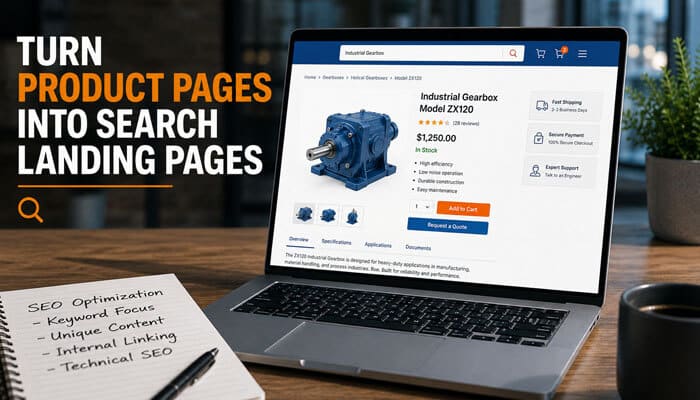
Product pages are a major opportunity in SEO for manufacturing companies, especially for manufacturers with large catalogs.
A page containing nothing more than:
Part A325 — Contact for Pricing
does not answer many questions.
Depending on the product, include:
- Product name
- Part number
- Dimensions
- Materials
- Grades
- Pressure ratings
- Temperature ranges
- Performance specifications
- Applicable standards
- Applications
- Available configurations
- Installation information
- Technical drawings
- CAD models
- Data sheets
- Related products
- Customization options
The objective is to turn each important product page into a useful technical resource rather than a digital catalog placeholder.
Control Faceted Navigation
Large product catalogs may allow buyers to filter by:
- Material
- Size
- Pressure
- Voltage
- Thread
- Application
- Industry
- Brand
Every filter combination can potentially generate another URL.
If uncontrolled, this can create huge numbers of duplicate or low-value pages.
Decide deliberately which filtered combinations deserve indexable landing pages.
A useful filter combination with actual search demand can become a landing page.
A meaningless combination should not automatically become one.
Make CAD Files and Engineering Assets Part of SEO
Technical downloads can signal valuable buying intent.
Depending on your business, provide:
- STEP files
- IGES files
- DXF files
- DWG files
- 2D drawings
- 3D CAD models
- Product data sheets
- Tolerance charts
- Material compatibility charts
- Installation drawings
- Technical manuals
However, do not hide all valuable information inside downloads.
Build crawlable HTML around the technical resource.
For example:
Industrial Valve Model 500
Include:
- Materials
- Dimensions
- Operating range
- Applications
- Standards
- Available sizes
Then offer:
- Download STEP File
- Download 2D Drawing
- Download Data Sheet
- Request Custom Configuration
This creates a useful search landing page while still serving engineers who need downloadable technical files.
4. Publish Technical Content Engineers and Buyers Actually Need
A strong Search engine optimization (SEO) for manufacturing companies content strategy should not become a collection of generic articles about business growth or industry news.
Publish content that solves real problems encountered during:
- Design
- Material selection
- Sourcing
- Quoting
- Production
- Quality control
- Supplier qualification
A CNC machining company could publish:
- CNC Milling vs CNC Turning: Which Process Should You Use?
- Aluminum 6061 vs 7075 for Machined Parts
- How Tight Tolerances Affect CNC Machining Cost
- How to Prepare CAD Files for CNC Machining
- Prototype Machining vs Production Machining
- What Factors Affect CNC Machining Lead Time?
An injection molding manufacturer might publish:
- ABS vs Polycarbonate for Injection Molding
- How Draft Angle Affects Mold Design
- Common Injection Molding Defects
- Prototype Tooling vs Production Tooling
- How Wall Thickness Affects Molded Parts
Find SEO Topics Inside Your Company
Some of your best keywords may already exist inside sales conversations.
Ask your sales, engineering, quoting, and quality teams:
- What questions do customers ask every week?
- Why do buyers request revised quotes?
- What information is commonly missing from RFQs?
- What mistakes regularly appear in drawings?
- Which materials do customers compare?
- Which tolerances increase cost?
- Which specifications create confusion?
- Which production decisions delay projects?
These questions represent real search demand and real customer problems.
Your employees can therefore become one of the most valuable research resources for SEO for manufacturing companies.
Target Certification and Specification Searches
Manufacturers should also create content around genuine qualification requirements.
Examples include:
- AS9100 CNC machining company
- ISO 13485 manufacturing supplier
- ITAR-registered machine shop
- RoHS-compliant component manufacturer
- food-grade stainless steel fabricator
- ASTM-compliant manufacturer
When relevant, explain:
- Certification name
- Scope
- Facilities covered
- Processes covered
- Industries supported
- Inspection capabilities
- Documentation available
Do not create a certification page just to repeat a keyword.
Explain what that certification means to a prospective customer.
Publish Comparison Content
Engineers frequently search while choosing a material, process, finish, or manufacturing method.
Useful topics include:
- 6061 vs 7075 aluminum
- CNC milling vs CNC turning
- Laser cutting vs waterjet cutting
- Stainless steel 304 vs 316
- Powder coating vs anodizing
- Die casting vs injection molding
- Prototype tooling vs production tooling
Comparison content can attract buyers earlier in the decision process and guide them toward relevant capability or product pages.
5. Create Industry Pages That Demonstrate Real Expertise
Many manufacturing websites simply state:
We serve aerospace, automotive, medical, defense, and industrial companies.
That does not demonstrate much expertise.
A better SEO for manufacturing companies strategy creates substantial pages for industries that matter commercially.
For example:
/industries/aerospace-manufacturing/
/industries/medical-device-manufacturing/
/industries/automotive-manufacturing/
An aerospace manufacturing page could cover:
- Aerospace materials
- Relevant processes
- Certifications
- Quality systems
- Traceability
- Inspection capabilities
- Production requirements
- Common components
- Relevant case studies
A medical manufacturing page might explain:
- Material traceability
- Process controls
- Precision requirements
- Validation
- Inspection
- Quality documentation
Each industry page should contain information specific to that sector instead of duplicating the same copy.
Build a Supplier Qualification Hub
Create a central page where prospective customers can quickly assess whether your company qualifies.
Potential URLs include:
/quality/
/supplier-information/
/supplier-qualifications/
Include:
- Certifications
- Regulatory registrations
- Equipment list
- Inspection equipment
- Materials processed
- Maximum dimensions
- Tolerances
- Prototype capabilities
- Production-volume ranges
- Secondary processes
- Traceability procedures
- Facility locations
- Industries served
- Drawing-upload capability
The easier you make supplier qualification, the easier it becomes for a buyer to move from search to RFQ.
6. Use Case Studies to Strengthen SEO for Manufacturing Companies
Marketing copy explains what you say you can do.
Case studies show what you have actually done.
That makes them especially valuable for manufacturing E-E-A-T, sales enablement, and conversion.
A useful case study can follow three simple stages.
Challenge
Explain the customer’s manufacturing problem without exposing confidential information.
Solution
Describe relevant technical details such as:
- Material
- Manufacturing process
- Equipment
- Tooling
- Fixture strategy
- Engineering changes
- Inspection plan
Result
Where possible, provide measurable outcomes:
- Reduced lead time
- Lower scrap
- Improved consistency
- Fewer assembly steps
- Higher throughput
- Better dimensional performance
Where confidentiality allows, include:
- Material
- Tolerance
- Production quantity
- Inspection method
- Industry
- Real photographs
Case studies can support:
- Organic rankings
- E-E-A-T
- Buyer confidence
- Internal linking
- Sales conversations
- RFQ conversion
Use Real Manufacturing Photography
Manufacturing is highly visual.
Original photographs provide credibility that generic stock imagery cannot.
Show:
- CNC machines
- Production cells
- Tooling
- Finished components
- Inspection laboratories
- Coordinate measuring machines
- Assembly operations
- Warehouses
- Factory floors
Use descriptive filenames.
Good:
5-axis-cnc-machining-center.jpg
Poor:
IMG4837.jpg
Use natural, descriptive alt text.
Good:
5-axis CNC machining center producing an aluminum aerospace component
Poor:
best seo cnc manufacturing company cheap machining manufacturer
Do not force SEO for manufacturing companies into every image alt attribute. Alt text should describe the image naturally.
Use Video Where It Adds Proof
Useful manufacturing videos include:
- Factory tours
- Machine demonstrations
- Inspection procedures
- Product demonstrations
- Installation guides
- Engineering explanations
- Project spotlights
The goal is not decoration.
The goal is evidence.
7. Strengthen Technical SEO for Manufacturing Companies
Content cannot perform well when Google struggles to crawl the site or buyers struggle to use it.
Technical SEO for manufacturing companies should include regular checks for:
- Indexability
- XML sitemaps
- Robots.txt
- Canonical tags
- Broken links
- Redirect chains
- Duplicate pages
- Mobile usability
- JavaScript rendering
- HTTPS
- Site architecture
- Structured data
- Page speed
- Internal links
Monitor Core Web Vitals
Important Core Web Vitals include:
| Metric | Good Threshold |
|---|---|
| Largest Contentful Paint (LCP) | ≤ 2.5 seconds |
| Interaction to Next Paint (INP) | ≤ 200 milliseconds |
| Cumulative Layout Shift (CLS) | ≤ 0.1 |
Manufacturing websites commonly become slow because of:
- Large factory photographs
- Autoplay videos
- PDF viewers
- Legacy JavaScript
- Old plugins
- Large product databases
- Complex filtering systems
Compress images, remove unnecessary scripts, improve caching, and keep technical information accessible without forcing buyers through heavy interfaces.
Keep URLs Simple and Descriptive
Prefer:
/services/5-axis-cnc-machining/
instead of:
/page?id=82719
Clear URLs make content easier for visitors, search engines, developers, and internal teams to understand.
8. Use Internal Linking to Strengthen SEO for Manufacturing Companies
A strong manufacturing website should behave like a connected technical knowledge base.
Suppose you publish:
Aluminum 6061 vs 7075 for CNC Machining
That article could link naturally to:
- Aluminum CNC machining
- CNC milling services
- Aerospace machining
- CNC tolerance guide
- Relevant case study
- Request-a-quote page
Your capability page can then link back to relevant engineering resources.
Useful pathways include:
Technical Guide → Capability → Industry → Case Study → RFQ
or:
Product → Specification → CAD Download → Request Quote
This improves navigation for buyers while helping search engines understand relationships between pages.
Avoid leaving profitable capability and product pages isolated deep within the website.
9. Use Local SEO for Manufacturing Companies With Real Facilities
Even manufacturers serving national customers can benefit from local search visibility.
Supplier location can affect:
- Freight costs
- Lead times
- Facility visits
- Domestic sourcing requirements
- Supply-chain risk
- Regional distribution
Potential searches include:
- CNC machining near me
- machine shop in Chicago
- metal fabricator in Texas
- injection molding company in Michigan
Keep your Google Business Profile accurate.
Important details include:
- Business name
- Address
- Phone
- Website
- Primary category
- Hours
- Photographs
- Business information
Create Genuine Facility Pages
If your business operates several legitimate facilities, create a useful page for each one.
Include:
- Address
- Processes performed
- Equipment
- Certifications
- Industries supported
- Facility photographs
- Contact details
Avoid creating location pages for cities where you have no genuine operation.
International SEO for Exporting Manufacturers
Manufacturers selling internationally may need localized content covering differences in:
- Language
- Terminology
- Measurements
- Currency
- Standards
- Certifications
- Distributors
- Shipping
A U.S. product page may use:
- Inches
- Fahrenheit
- ASTM standards
A European version may use:
- Millimeters
- Celsius
- DIN or EN standards
Translation alone may therefore be insufficient.
If you maintain different language or regional versions, use a clear international URL structure and appropriate localization signals.
10. Earn Industrial Backlinks and Supplier Citations
Links can strengthen SEO for manufacturing companies, but relevance matters more than collecting the largest possible number.
Potential industrial link opportunities include:
- Industry associations
- Supplier directories
- Customers
- Distributors
- Certification organizations
- Chambers of commerce
- Universities
- Trade publications
- Engineering resources
- Manufacturing partners
- Economic-development organizations
The principle is straightforward:
Be visible wherever real industrial buyers reasonably expect to find qualified suppliers.
Avoid buying hundreds of unrelated links simply to increase third-party SEO metrics.
A relevant trade association, distributor, customer, engineering publication, or respected industrial directory may provide more strategic value than dozens of generic directories.
11. Optimize Every Important Page for RFQs
Ranking is only useful when the right visitor can take the next step. The ultimate objective of SEO for manufacturing companies should be turning relevant search visibility into qualified opportunities.
Every important commercial page should have a clear CTA.
Examples include:
- Request a Quote
- Upload Your Drawing
- Talk to an Engineer
- Request a Sample
- Download CAD
- Download the Catalog
- Discuss Your Project
- Ask About This Product
Make RFQ Forms Easy to Complete
Collect enough information to evaluate the opportunity without introducing unnecessary friction.
Useful fields may include:
- Name
- Company
- Phone
- Project description
- Material
- Quantity
- Required delivery date
- Drawing upload
Support relevant technical files wherever practical.
Put Trust Signals Near the CTA
Useful proof includes:
- Certifications
- Regulatory registrations
- Years in operation
- Equipment
- Inspection capabilities
- Industries served
- Production volumes
- Facility photographs
- Relevant case studies
- Customer-approved testimonials
A prospective customer should not need to visit six separate pages just to determine whether your company can handle the project.
How AI Overviews Affect SEO for Manufacturing Companies
AI search experiences do not eliminate the need for strong SEO for manufacturing companies.
The fundamentals remain valuable:
- Crawlable content
- Clear site architecture
- Helpful technical information
- Original experience
- Descriptive headings
- Internal linking
- Accurate specifications
- Strong commercial pages
AI-driven search also reinforces the importance of topical depth.
Instead of creating one shallow page about:
CNC machining
build a connected content ecosystem covering:
- CNC machining
- 5-axis machining
- Aluminum machining
- Aerospace machining
- AS9100 machining
- CNC tolerances
- 6061 vs 7075 aluminum
- Machining lead times
- Machining case studies
Think in terms of:
Process + Material + Application + Specification + Certification + Comparison
This is one of the strongest opportunities for manufacturers.
Your engineers, estimators, machinists, production staff, and quality specialists possess firsthand experience that generic mass-produced content cannot easily reproduce.
Turn that operational knowledge into useful website content.
Use Structured Data Where It Makes Sense
Structured data can help search engines better understand certain information on manufacturing websites.
Relevant types may include:
- Organization
- LocalBusiness
- Breadcrumb
- Article
- Product
- ProductGroup
Use markup only when it accurately represents information already visible to users.
Structured data is not a shortcut to higher rankings.
What About FAQ Schema?
FAQs can still be valuable for:
- Readers
- Long-tail keywords
- Topic completeness
- Internal linking
- Search intent coverage
However, write FAQs because they improve the article—not simply because you expect additional search-result features.
How to Measure SEO for Manufacturing Companies
Do not measure SEO for manufacturing companies only by whether website traffic increased.
Measure commercial behavior.
| Metric | Why It Matters |
|---|---|
| Organic impressions | Shows search visibility |
| Organic clicks | Measures organic acquisition |
| Buyer-intent rankings | Tracks commercial keyword visibility |
| Capability-page visits | Shows supplier research |
| CAD downloads | Signals technical interest |
| Drawing uploads | Indicates strong project intent |
| RFQ submissions | Measures direct opportunities |
| Qualified calls | Measures sales engagement |
| Sales-qualified leads | Measures lead quality |
| Quotes issued | Connects SEO with pipeline |
| Closed revenue | Measures business impact |
Track Search Through the Entire Sales Funnel
A manufacturing buyer may:
- Find a technical guide through Google.
- Visit a capability page.
- Download a CAD file.
- Return several weeks later.
- Upload a drawing.
- Speak with engineering.
- Receive a quote.
- Become a customer.
If measurement ends after the first visit, SEO may receive little credit for the revenue it helped generate.
Track Micro-Conversions
Monitor actions such as:
- RFQ button clicks
- Form starts
- Form submissions
- CAD downloads
- PDF downloads
- Catalog downloads
- Drawing uploads
- Email clicks
- Phone clicks
- Sample requests
The ideal measurement model is:
Organic Search → RFQ → Qualified Lead → Quote → Customer → Revenue
A keyword producing 25 visits per month can be more valuable than one producing 5,000 if those 25 visitors repeatedly become qualified opportunities.
A 90-Day SEO for Manufacturing Companies Action Plan
If your website needs extensive improvements, prioritize the work closest to revenue.
| Period | Priority |
|---|---|
| Days 1–30 | Technical audit, analytics, keyword research, and conversion tracking |
| Days 31–60 | Optimize capability, product, industry, and qualification pages |
| Days 61–90 | Build technical resources, case studies, and authority |
Days 1–30: Build the Foundation
Focus on:
- Indexing problems
- Duplicate pages
- Search Console
- Analytics
- RFQ tracking
- Keyword mapping
- Page-speed problems
- Existing ranking opportunities
Pay particular attention to pages already receiving impressions but ranking below the strongest positions.
Improving an existing page can sometimes generate results faster than creating a new one.
Days 31–60: Improve Revenue Pages
Prioritize:
- Core capability pages
- High-value products
- Material pages
- Industry pages
- Certification pages
- Quality information
- Facility pages
- RFQ experience
Ask:
Would a qualified industrial buyer have enough information to shortlist our company?
If the answer is no, improve the page.
Days 61–90: Build Supporting Authority
Create:
- Technical guides
- Material comparisons
- Process comparisons
- Case studies
- Engineering resources
- Original photography
- Videos
- Supplier citations
- Internal links
Then use actual search and sales data to determine what deserves further investment.
Maintain Your SEO for Manufacturing Companies Content
Manufacturing information changes.
Machines are added and retired.
Certifications renew.
Products change.
Facilities expand.
Technical downloads become outdated.
Review commercially important pages regularly for:
- Certification dates
- Equipment lists
- Product availability
- Materials
- Tolerances
- CAD files
- Technical data sheets
- Broken links
- Structured data
- Facility information
- Contact details
- Case studies
- RFQ forms
An accurate technical page can remain useful for years.
A capability page advertising equipment you no longer operate can damage buyer confidence.
Content maintenance is therefore not simply an SEO task.
It is part of supplier qualification.
Common SEO for Manufacturing Companies Mistakes
Avoid these common problems:
- Putting every capability on one generic service page
- Publishing thin product descriptions
- Targeting only high-volume keywords
- Creating generic AI-generated articles
- Ignoring specification searches
- Ignoring certification searches
- Hiding important information entirely inside PDFs
- Failing to provide CAD resources
- Creating hundreds of duplicate city pages
- Relying only on stock factory photography
- Displaying outdated certifications
- Ignoring Core Web Vitals
- Creating uncontrolled filter URLs
- Leaving important commercial pages internally isolated
- Making RFQ forms unnecessarily complicated
- Measuring traffic without measuring lead quality
- Ignoring revenue attribution
Should Manufacturers Keep PDF Catalogs?
Yes—but PDFs should support your website rather than replace it.
Buyers may still want downloadable:
- Product catalogs
- Technical data sheets
- Certificates
- Installation manuals
- Specification documents
However, commercially important information should also appear on crawlable HTML pages whenever practical.
That gives manufacturers pages that can be:
- Crawled
- Indexed
- Internally linked
- Updated easily
- Measured
- Structured
- Optimized for RFQs
Think of the HTML page as the searchable entry point and the PDF as a supporting technical resource.
A Strong SEO for Manufacturing Companies Website Structure
A scalable manufacturing SEO architecture might look like this:
Home
→ Capabilities
→ CNC Machining
→ CNC Milling
→ CNC Turning
→ Materials
→ Aluminum
→ Stainless Steel
→ Titanium
→ Industries
→ Aerospace
→ Medical
→ Automotive
→ Products
→ Product Categories
→ Individual Products
→ Resources
→ Technical Guides
→ Material Comparisons
→ Process Comparisons
→ Case Studies
→ FAQs
→ Quality
→ Certifications
→ Equipment
→ Supplier Information
→ Company
→ About
→ Facilities
→ Locations
→ Request a Quote
This structure mirrors the questions buyers naturally ask:
What do you manufacture?
Can you manufacture my component?
Can you meet my technical requirements?
Have you completed similar projects?
How do I request a quote?
SEO for Manufacturing Companies Checklist
Before considering your strategy, make sure your website clearly answers:
- What does your company manufacture?
- Which manufacturing processes do you perform?
- Which materials do you handle?
- What tolerances can you achieve?
- What production volumes do you support?
- Which machines do you operate?
- What certifications do you maintain?
- Which industries do you serve?
- Where are your facilities?
- What inspection capabilities are available?
- Can customers download CAD files?
- Can buyers view case studies?
- Is important technical information available in HTML?
- Can visitors request a quote quickly?
- Can customers upload drawings?
- Are RFQs tracked through the sales pipeline?
- Can organic search be connected to qualified revenue?
If several of these answers are difficult to find, your website probably still has meaningful SEO and conversion opportunities.
Final Thoughts on SEO for Manufacturing Companies
Effective SEO for manufacturing companies is not about chasing more website traffic. It is about helping engineers, procurement managers, OEM buyers, and other qualified decision-makers find your capabilities, products, certifications, and technical expertise when they are actively searching for a supplier.
A strong SEO for manufacturing companies strategy combines buyer-intent keywords, optimized capability and product pages, technical content, case studies, internal linking, local SEO, and clear RFQ calls to action. When these elements work together, organic search can attract better-qualified leads and support the entire supplier-selection process.
Most importantly, measure SEO for manufacturing companies by real business results such as CAD downloads, drawing uploads, RFQs, qualified leads, quotes, pipeline, and revenue. When your website answers the right technical questions at the right time, SEO becomes more than a ranking strategy—it becomes a long-term customer-acquisition channel.
SEO for Manufacturing Companies FAQs
1. What Is SEO for Manufacturing Companies?
SEO for manufacturing companies is the process of optimizing a manufacturer’s website so engineers, procurement teams, OEM buyers, and other potential customers can find its products, services, capabilities, and technical information through search engines.
2. Why Is SEO for Manufacturing Companies Important?
SEO for manufacturing companies helps manufacturers appear when qualified buyers search for products, processes, materials, certifications, specifications, or suppliers. The goal is not only more traffic, but more qualified RFQs and sales opportunities.
3. What Are the Best Keywords for SEO for Manufacturing Companies?
The best keywords combine commercial intent with real manufacturing capabilities. Strong examples include process keywords, material keywords, industry terms, certification searches, specification keywords, location terms, and supplier-focused phrases such as “AS9100 CNC machining supplier.”
4. How Can SEO for Manufacturing Companies Generate More RFQs?
SEO can generate RFQs by attracting buyers who are actively searching for manufacturing suppliers. Capability pages, product pages, technical resources, certifications, case studies, and clear calls to action such as Request a Quote or Upload Your Drawing can help turn organic visitors into qualified leads.
5. How Should Manufacturers Measure SEO ROI?
Manufacturers should measure SEO beyond rankings and traffic. Track the complete journey:
Organic Search → Website Visit → CAD Download → RFQ → Qualified Lead → Quote → Customer → Revenue
This shows whether SEO for manufacturing companies is creating real business value.

Source: Cosmo Politian