


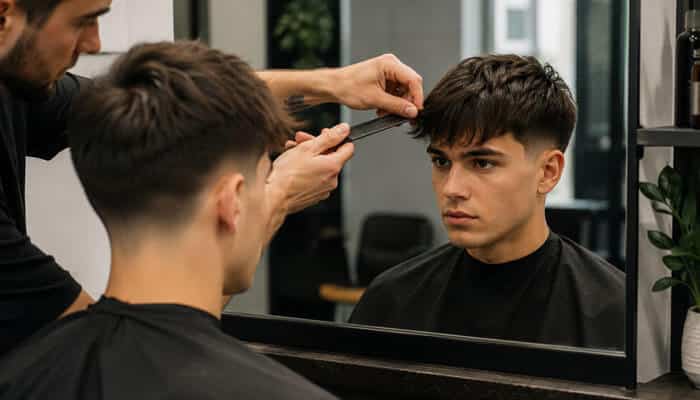
The Low Taper Fade with Textured Fringe Haircut combines clean, gradually blended edges with a layered fringe that adds movement, volume, and personality. The taper remains close to the temples, sideburns, ears, and neckline, while the longer top is styled toward the forehead in soft, separated sections.
Unlike a high fade, this haircut preserves more fullness through the upper sides. That softer contrast makes it adaptable for straight, wavy, curly, thick, fine, coarse, and Afro-textured hair. The fringe can be worn short and choppy, loose and messy, fluffy, curly, side-swept, or professionally controlled.
The style also fits the broader direction of men’s grooming in 2026, which favors softer tapers, natural texture, less severe disconnection, and haircuts that retain their shape as they grow.
This guide explains 25 of the best variations, suitable hair types and face shapes, barber instructions, required hair length, styling techniques, product choices, maintenance, and solutions for common haircut problems.
Quick Answer: Low Taper Fade with Textured Fringe Haircut
A Low Taper Fade with Textured Fringe Haircut gradually shortens the hair around the lower temples, sideburns, ears, and neckline while leaving more length on top. The front is layered or point-cut to create an uneven, separated fringe instead of one heavy horizontal line.
Ask your barber for:
- A taper concentrated around the temples and neckline
- Weight preserved above the ears
- A softly blended transition into the longer top
- A layered or point-cut fringe
- A fringe length suited to your forehead and hair texture
- A natural finish rather than an excessively sharp high fade
- Enough length on top to create visible separation and movement
Bring two or three reference images showing the front, side, and back. Haircut terminology varies between barbers, so clear photographs and precise instructions are more reliable than using only the haircut name.
Key Takeaways
- A low taper cleans the perimeter without removing excessive fullness from the sides.
- A textured fringe can be adapted for straight, wavy, curly, thick, fine, or coarse hair.
- Fine hair should not be aggressively thinned.
- Thick hair may need controlled internal weight removal.
- Curly hair must be cut with shrinkage in mind.
- Cowlicks usually require a side-swept, broken, or lifted fringe.
- Matte products generally create a more natural finish than heavy wet-look products.
- A standard low taper often looks freshest when cleaned every three to four weeks.
- The best Low Taper Fade with Textured Fringe Haircut is customized to the individual rather than copied exactly from a reference photograph.
What Is a Low Taper Fade with Textured Fringe?
The style contains two main elements: a low taper haircut fade and a textured fringe.
The Low Taper Fade
A low taper gradually shortens the hair around the natural perimeter of the head. The shortest areas usually appear near the:
- Sideburns
- Lower temples
- Edges around the ears
- Lower neckline
- Nape
The transition stays close to the natural hairline instead of rising into the middle or upper sides.
Depending on the requested result, the lowest section may be cut:
- Down to bare skin
- With a zero setting
- With a half guard
- With a No. 1 guard
- With scissors for a softer finish
A lower starting point creates a subtle taper. Moving the shortest section higher produces a stronger fade and removes more weight from the sides.
The Textured Fringe
The fringe is the front section of hair that falls toward or across the forehead. Instead of cutting the front into one uniform edge, the barber creates slightly different lengths, layers, or separated sections.
Possible techniques include:
- Point cutting
- Internal layering
- Slide cutting
- Twist cutting
- Scissor-over-comb
- Razor texturing
- Controlled thinning
- Clipper-over-fingers
The purpose of texturizing is not simply to make the hair look messy. Good texture reduces unnecessary bulk while preserving enough density for the fringe to fall naturally.
Fine hair usually needs minimal thinning. Dense or coarse hair may require more internal weight removal to prevent the front from looking heavy or rounded.
Together, these two elements create the Low Taper Fade with Textured Fringe Haircut: clean around the perimeter, fuller through the sides, and naturally separated through the front.
Low Taper vs. Low Fade vs. Taper Fade
These terms are related, but they do not always describe the same haircut.
| Haircut | Main characteristics | Hair removed | Overall appearance |
| Low taper | Shortens small areas around the temples and neckline | Minimal | Subtle and natural |
| Low fade | Creates a wider gradient around the lower sides and back | Moderate | Cleaner and more contrasted |
| Low skin fade | Blends the lowest section down to bare skin | High | Sharp and highly defined |
| Low taper fade | Combines a concentrated taper with a smooth fade-like blend | Low to moderate | Clean without looking severe |
| Temple fade | Focuses mainly on the temples and sideburns | Minimal | Preserves fullness at the back |
| Drop fade | Curves downward behind the ears | Moderate | Follows the natural head shape |
| Scissor taper | Uses mainly scissors instead of a close clipper blend | Minimal | Soft and natural |
The words “low,” “mid,” and “high” generally describe how far the shortest part of the blend extends above the ear. A higher fade creates a more visible transition. A low taper preserves more side hair and normally grows out more softly. For the most versatile result, ask the barber to keep the shortest area close to the natural hairline and retain weight above the ears.
Why Is This Haircut Popular in 2026?
The Low Taper Fade with Textured Fringe Haircut works well with several current men’s grooming preferences.
Softer Tapers Are Gaining Popularity
Men are increasingly choosing natural necklines, softer blends, and haircuts that still look intentional after several weeks of growth.
A low taper fits this preference because it cleans the temples and neckline without removing all the fullness from the sides.
Fringes Add Movement Without Requiring Long Hair
The wearer gets visible texture and personality without growing the length required for a shag, long curtains, or a full flow hairstyle.
It Works With Natural Hair Texture
Waves and curls can form the fringe naturally. Straight hair can achieve a similar effect through layering, blow-drying, and lightweight matte products.
It Offers Several Styling Options
The front can be:
- Worn loose and messy
- Cut short and choppy
- Lifted for additional volume
- Swept diagonally
- Split into soft curtains
- Defined into individual curls
- Styled neatly for formal settings
It Can Grow Out Gracefully
Because the taper remains low, regrowth is usually less obvious than it would be with a high skin fade.
The longer top can also transition into:
- A side-swept fringe
- Curtains
- A longer textured crop
- A short flow hairstyle
- A mini mullet
- A messy quiff
This flexibility makes the haircut suitable for men who want a current style without committing to an extreme fade or a high-maintenance longer cut.
Who Does a Low Taper Fade with Textured Fringe Suit?
A Low Taper Fade with Textured Fringe Haircut can work with most hair textures, but the barber should adjust the cutting method according to density, curl pattern, and natural movement.
| Hair type | Recommended approach | Suitable product | Main concern |
| Straight and thick | Remove internal bulk and create uneven layers | Matte clay | Heavy, block-like fringe |
| Straight and fine | Preserve density and add light separation | Volumizing spray | Flatness or visible scalp |
| Wavy | Follow the natural wave pattern | Sea-salt spray or light cream | Frizz |
| Curly | Keep enough length for curl formation | Curl cream or light gel | Shrinkage |
| Coarse | Use controlled debulking | Conditioning cream and clay | Puffiness and dryness |
| Afro-textured | Shape according to curl pattern and density | Leave-in conditioner or curl product | Moisture loss and buildup |
| Oily | Use lightweight matte products | Texture powder or light paste | Greasy separation |
| Dry | Reduce drying sprays and increase conditioning | Leave-in conditioner or cream | Brittleness and frizz |
1. Straight Hair
Straight hair normally needs deliberate layering to prevent the top from falling into one flat sheet. Point cutting and light internal texturing can create separation.
2. Wavy Hair
Waves often produce ideal natural movement for this style. The barber should follow the wave pattern instead of cutting the fringe into a rigid horizontal line.
3. Curly Hair
Curly hair works well when sufficient length is preserved. Cutting the front too short may cause it to spring above the intended position after drying.
4. Fine Hair
Fine hair should be texturized carefully. Aggressive thinning may reduce the visible density of the fringe and expose more scalp.
5. Thick Hair
Thick hair may require internal weight removal. The goal is to reduce bulk beneath the surface while maintaining a full outer shape.
6. Afro-Textured Hair
A low taper can create a clean outline while preserving curls, coils, or twists through the top. The barber should work with the natural pattern and avoid removing excessive moisture or density.
Best Face Shapes for a Textured Fringe
Face-shape guidance should be treated as a customization tool rather than a strict rule. Hairline, forehead height, beard shape, hair density, and personal preference also influence the result.
| Face shape | Recommended fringe adjustment | What to avoid |
| Oval | Most short, medium, or messy fringes | Covering too much of balanced features |
| Round | Add lift or use a diagonal fringe | Thick, completely flat fringe |
| Square | Use softer texture to balance a strong jaw | Extremely rigid, box-shaped front |
| Oblong | Let the fringe cover part of the forehead | Excessive height |
| Heart | Retain some width around the temples | Removing too much upper-side weight |
| Diamond | Use a wider, softer fringe | Very high fade with a narrow top |
| Triangle | Keep fullness above the ears | Tight sides combined with a very heavy beard |
1. Round Faces
A broken or slightly elevated fringe adds structure. A thick, flat fringe may make the face appear wider.
2. Long or Oblong Faces
A medium-length fringe can cover part of the forehead and reduce the appearance of vertical length.
3. Square Faces
Soft, uneven texture can balance strong facial angles without hiding the jawline.
4. Diamond or Heart-Shaped Faces
Preserving some side weight helps prevent the upper head from appearing too narrow.
Does the Haircut Work With a Cowlick or Receding Hairline?
A cowlick, widow’s peak, or receding hairline does not automatically rule out the Low Taper Fade with Textured Fringe Haircut. The fringe simply needs to be adapted to the natural growth pattern.
1. Front Cowlick
A strong cowlick may cause one side of the fringe to lift, split, or move backward.
Suitable options include:
- A longer side-swept fringe
- A broken fringe that follows the natural direction
- A lifted messy fringe
- An asymmetrical front
- A short Caesar-inspired fringe
- Soft curtains
Avoid cutting the resistant section too short before checking how it behaves when dry.
2. Widow’s Peak
A choppy or lightly separated fringe can soften the visible outline of a widow’s peak. A rigid line-up may emphasize an irregular hairline unless that sharp finish is intentional.
3. Receding Temples
A forward fringe may reduce the visual prominence of temple recession, but a haircut cannot stop or treat hair loss.
Suitable variations include:
- Soft Caesar fringe
- Short curtains
- Side-swept textured crop
- Messy forward fringe
- Scissor taper with fuller temples
Fine or thinning hair should not be aggressively thinned. Sudden shedding, scalp irritation, or progressive hair loss should be assessed by an appropriate healthcare professional.
25 Best Low Taper Fade with Textured Fringe Haircut Styles
1. Classic Low Taper Fade with Textured Fringe
The classic version keeps the temples and neckline neat while preserving enough side weight to connect naturally with the top. The fringe usually sits between the upper forehead and eyebrows. It is separated with the fingers instead of being shaped into one heavy line.
- Best for: Straight, wavy, or moderately thick hair
- Recommended product: Matte paste
- Maintenance level: Moderate
2. Short Choppy Textured Fringe with Low Taper
This version uses short, irregular sections through the front. It resembles a softer French crop but avoids a perfectly straight fringe. It is practical for active lifestyles, warm climates, and men who dislike hair falling into their eyes.
- Best for: Straight or thick hair
- Recommended product: Texture powder
- Finish: Dry and separated
3. Messy Low Taper Fade with Textured Fringe
The messy version retains additional length and emphasizes irregular movement. The top should still have an intentional shape. Proper layers create controlled disorder, while an unlayered top may simply appear overgrown.
- Best for: Medium-density straight or wavy hair
- Recommended product: Sea-salt spray and matte paste
- Finish: Relaxed and natural
4. Wavy Textured Fringe with Low Taper Fade
Natural waves supply movement without requiring heavy styling. The barber should cut according to the wave pattern and leave enough length for the bends to form.
- Best for: Naturally wavy hair
- Recommended product: Light curl cream or sea-salt spray
- Avoid: Excessive thinning
5. Curly Fringe with Low Taper Fade
This variation keeps the curls full on top while cleaning the temples and neckline. The fringe may form individual curls over the forehead instead of one continuous edge.
- Best for: Loose or medium curls
- Recommended product: Curl cream or lightweight gel
- Main consideration: Dry shrinkage
6. Straight-Hair Low Taper with Piecey Fringe
Straight hair can produce a clearly textured effect when the front is point-cut and separated into narrow sections. A matte product helps the individual pieces remain visible without creating a greasy finish.
- Best for: Straight, medium-to-thick hair
- Recommended product: Matte clay
- Avoid: Heavy wet-look gel
7. Thick-Hair Textured Fringe with Debulked Top
Very thick hair may become heavy, rounded, or difficult to control. Strategic internal weight removal improves movement while preserving visible fullness on the surface.
- Best for: Dense or coarse hair
- Recommended product: Stronger matte clay
- Main benefit: Better control
8. Fine-Hair Low Taper with Soft Fringe
Fine hair benefits from preserved density and restrained texturizing. Light root lift can make the fringe look fuller, while heavy waxes may cause the hair to separate and reveal more scalp.
- Best for: Fine or lower-density hair
- Recommended product: Volumizing spray or lightweight paste
- Avoid: Aggressive thinning
9. Fluffy Textured Fringe with Low Taper
The fluffy variation uses medium length, root lift, and a soft rounded silhouette. The taper should remain low so the sides support the volume rather than making the top appear unusually wide.
- Best for: Straight-to-wavy hair
- Recommended product: Volumizing mousse or sea-salt spray
- Styling tool: Blow dryer
10. French Crop with Low Taper and Textured Fringe
This style combines the compact shape of a French crop with a broken, irregular front. It works well for men who want visible texture without a long or high-maintenance fringe.
- Best for: Straight, thick, or slightly wavy hair
- Recommended product: Matte paste
- Maintenance level: Relatively low
11. Blunt Textured Fringe with Soft Taper
A blunt fringe has a noticeable horizontal shape, but light point cutting prevents it from becoming a solid block. The result has more structure than a messy fringe without becoming as severe as a traditional Edgar.
- Best for: Dense, straight hair
- Recommended product: Light clay
- Avoid: Cutting the fringe too high
12. Asymmetrical Textured Fringe
The asymmetrical version is intentionally longer on one side. It introduces directional movement and may also work with a natural part or uneven growth pattern.
- Best for: Straight or wavy hair
- Recommended product: Flexible paste
- Style: Creative and fashion-forward
13. Side-Swept Textured Fringe
Instead of falling directly forward, the fringe moves diagonally across the forehead. This variation works well in professional environments, with cowlicks, and for men who do not want the entire forehead covered.
- Best for: Straight, fine, or wavy hair
- Recommended product: Lightweight cream
- Finish: Controlled and natural
14. Caesar-Inspired Low Taper with Short Fringe
This variation uses a short forward fringe and compact top. Modern versions introduce more separation and softer edges than a traditional Caesar cut.
- Best for: Men who prefer short hairstyles
- Recommended product: Matte paste
- Daily styling: Low
15. Blowout Textured Fringe with Low Taper
The blowout version adds height and outward movement while retaining some forward direction. It works best when the hair has enough density to maintain a larger silhouette.
- Best for: Thick or wavy hair
- Recommended product: Pre-styling spray and clay
- Maintenance level: Medium to high
16. Low Skin Taper with Textured Fringe
This sharper variation takes the lowest areas around the temples and neckline down to bare skin. The skin section should stay concentrated near the perimeter to preserve the low-taper effect.
- Best for: Men who prefer stronger edge definition
- Maintenance level: High
- Typical refresh: Every two to three weeks
17. Low Drop Taper Fade with Textured Fringe
A drop taper curves downward behind the ears rather than following a straight horizontal path. It follows the natural head shape and retains more weight toward the back.
- Best for: Thick, wavy, or curly hair
- Main benefit: Sculpted side profile
- Avoid: Taking the drop too high
18. Temple Taper with Long Textured Fringe
A temple taper focuses mainly on the sideburns and temples while leaving the back fuller. It suits men growing the top or rear length who still want a clean frame around the face.
- Best for: Medium-length or growing hair
- Recommended product: Styling cream
- Maintenance: Lower than a full fade
19. Neck Taper with Natural Fringe
This understated version concentrates the taper at the nape while leaving the sides mostly natural. It works well in conservative workplaces and for men who want minimal clipper exposure.
- Best for: Professional and understated styles
- Recommended product: Light paste
- Overall effect: Soft and polished
20. Disconnected Textured Fringe with Low Taper
The disconnected version creates stronger contrast between the longer top and shorter sides. It delivers dramatic volume but must be shaped carefully to avoid an accidental bowl effect.
- Best for: Thick, straight, or wavy hair
- Recommended product: Medium-to-strong clay
- Maintenance level: High
21. Long Textured Fringe with Low Taper
The long fringe reaches the eyebrows or falls slightly below them. It can be worn forward, swept sideways, divided into curtains, or pushed backward.
- Best for: Straight, wavy, or loose-curly hair
- Recommended product: Lightweight cream
- Main advantage: Styling flexibility
22. Micro Textured Fringe with Low Taper
A micro fringe sits higher on the forehead and uses very short irregular sections. It creates a stronger editorial appearance and exposes more of the forehead and hairline.
- Best for: Dense, straight, or slightly wavy hair
- Recommended product: Texture powder
- Maintenance: Frequent front reshaping
23. Highlighted Textured Fringe
Subtle highlights can make individual layers, waves, and curls more visible. Color-treated hair may need additional conditioning because chemical processing can increase dryness.
- Best for: Hair lacking visible dimension
- Recommended product: Color-safe styling cream
- Maintenance: Haircut and color upkeep
24. Textured Fringe with Low Taper and Beard
Pairing the haircut with facial hair creates continuity between the taper, sideburns, and beard. The barber can blend the sideburn directly into the beard or leave a more defined separation.
- Best for: Men wanting a complete grooming style
- Important detail: Coordinate the beard transition
- Maintenance: Hair and beard cleanup
25. Professional Low Taper with Controlled Fringe
The professional variation keeps the fringe shorter, lighter, and easy to redirect. It can be worn forward casually or moved diagonally for meetings and formal settings.
- Best for: Offices and client-facing roles
- Recommended product: Light matte paste
- Finish: Neat without appearing rigid
Which Variation Should You Choose?
Choosing the best Low Taper Fade with Textured Fringe Haircut depends on your hair type, styling time, climate, workplace, and preferred level of contrast.
| Your priority | Best variation |
| Lowest styling effort | Short choppy or Caesar-inspired fringe |
| Maximum natural texture | Wavy or curly fringe |
| More volume | Fluffy or blowout fringe |
| Professional appearance | Controlled or side-swept fringe |
| Strong contrast | Low skin taper |
| Softer grow-out | Classic taper or temple taper |
| Thick-hair control | Debulked textured top |
| Fine-hair fullness | Soft fringe with preserved density |
| Fashion-forward appearance | Micro or asymmetrical fringe |
| Maximum flexibility | Long textured fringe |
| Better cowlick control | Side-swept or broken fringe |
| Warmer climate | Short choppy fringe |
Low Taper Textured Fringe vs. Edgar Haircut
The two styles can overlap, but they are not automatically the same.
| Feature | Textured fringe with low taper | Edgar haircut |
| Front line | Broken, layered, or uneven | Traditionally straight and defined |
| Top | Soft, messy, wavy, or piecey | Usually compact and forward |
| Shape | Natural and customizable | Often square or geometric |
| Sides | Low taper, low fade, or soft blend | Commonly paired with a fade |
| Styling options | Forward, diagonal, lifted, or divided | Usually styled forward |
| Overall effect | Relaxed and adaptable | Bolder and more recognizable |
A traditional Edgar normally has a straighter fringe and more compact top. A textured fringe generally retains additional length and softer, uneven movement.
How a Barber Creates the Haircut
A well-executed Low Taper Fade with Textured Fringe Haircut requires more than simply fading the sides and pushing the top forward. The barber must balance the taper height, side weight, top length, density, and natural growth pattern.
1. Consultation
The barber evaluates:
- Natural growth direction
- Hair density
- Curl or wave pattern
- Cowlicks
- Hairline shape
- Existing layers
- Desired fringe position
- Preferred taper contrast
The desired result should be discussed while the hair is still in its natural state.
2. Establishing the Taper Area
The barber determines where the shortest section will begin around the sideburns, temples, ears, and neckline. The starting length may be skin, zero, or a longer guard depending on the desired contrast.
3. Building the Blend
Gradually longer clipper settings, lever adjustments, or clipper-over-comb techniques are used to soften visible guidelines. The barber should step back regularly to ensure the taper has not climbed too high.
4. Preserving Side Weight
Enough hair should remain above the taper to connect the longer top with the sides. Removing too much fullness may turn a low taper into a mid fade or create an unwanted disconnected shape.
5. Cutting the Top
The top is shortened according to the desired fringe length and silhouette. Fine hair usually needs preserved density. Thick hair may require internal bulk removal.
6. Shaping the Fringe
The barber point-cuts or layers the front according to how it will sit when dry. Wavy and curly hair must be checked for shrinkage before the final length is established.
7. Drying and Refining
The hair should be dried close to the way it will normally be worn. The barber then checks:
- Fringe direction
- Side-to-side balance
- Dark patches in the blend
- Excessive bulk
- Uneven layers
- Final dry length
Final texturizing should be conservative because removed density cannot be restored during the appointment.
How to Ask Your Barber for the Haircut
Do not rely only on the haircut name. Explain the taper, side weight, top length, and fringe separately.
Barber Request Script
“I want a Low Taper Fade with Textured Fringe Haircut that stays close to the temples, sideburns, ears, and neckline. Please keep weight through the upper sides and do not take the fade too high. Leave enough length on top for a textured fringe, remove internal bulk only where necessary, and point-cut the front so it looks separated rather than blunt. I want the dry fringe to finish around this part of my forehead.”
Show the barber exactly where you want the dry fringe to finish.
Details to Confirm Before Cutting
Ask:
- How low will the taper begin?
- Will the lowest section reach skin?
- How much weight will remain above the ears?
- Will the top connect naturally with the sides?
- Where will the fringe finish when dry?
- How much curl shrinkage should be expected?
- Are thinning shears suitable for your density?
- How should the finished haircut be styled?
- How often will the taper need cleaning?
Suggested Length Guide
These measurements are starting points rather than fixed rules.
| Section | Suggested starting length | Likely result |
| Short top | 1.5–2 inches | Compact and easy to maintain |
| Medium top | 2–3 inches | Balanced texture |
| Long top | 3–5 inches | Fluffy, wavy, or flowing |
| Short fringe | Upper forehead | Clean and practical |
| Medium fringe | Mid-forehead to eyebrows | Most versatile |
| Long fringe | Eyebrows or lower | Dramatic and flexible |
| Lowest taper | Skin to approximately No. 1 | Determines contrast |
The barber may adjust these lengths according to density, curl pattern, cowlicks, and growth direction.
How Long Does Your Hair Need to Grow?
Most versions of the Low Taper Fade with Textured Fringe Haircut require enough length at the front to create separation and movement. Scalp hair commonly grows at approximately one centimetre per month on average, although individual growth rates and hair cycles vary.
| Additional length needed | Approximate growing time | Suitable goal |
| 0.5 inch | About 4–6 weeks | Very short choppy fringe |
| 1 inch | About 2–3 months | Short-to-medium fringe |
| 1.5 inches | About 3–4 months | Fuller messy or wavy fringe |
| 2 inches | About 4–6 months | Fluffy or eyebrow-length fringe |
| More than 2 inches | Six months or longer | Long fringe or curtains |
These are planning estimates rather than guaranteed timelines.
What to Do While Growing the Front
- Request only temple and neckline cleanups.
- Tell the barber that you are growing the front.
- Avoid shortening the top during every appointment.
- Preserve side weight to prevent an undercut shape.
- Use a side-swept style during awkward stages.
- Condition dry ends to reduce breakage.
- Take the same reference image to each appointment.
Regular trimming can remove damaged ends, but it does not make hair grow faster from the scalp.
How to Style a Low Taper Fade with Textured Fringe
The routine depends on whether you want a messy, fluffy, wavy, curly, flat, or side-swept finish.
Five-Minute Everyday Routine
- Begin with clean or lightly damp hair.
- Blot away excess water gently.
- Apply a small amount of pre-styling product.
- Direct the hair forward with your fingers.
- Blow-dry on low or medium heat.
- Lift the roots when extra volume is needed.
- Rub a small amount of matte product between your palms.
- Apply it from the back toward the front.
- Pinch selected fringe sections together.
- Stop before the hair becomes stiff or overloaded.
How to Style Straight Hair
- Apply volumizing spray or sea-salt spray to damp hair.
- Blow-dry briefly against the natural growth direction.
- Redirect the hair forward as it dries.
- Finish with texture powder, matte paste, or clay.
- Apply product through the whole top instead of only the fringe.
How to Style Wavy Hair
- Apply lightweight curl cream or sea-salt spray.
- Scrunch the hair instead of brushing it flat.
- Air-dry or use a diffuser on low heat.
- Separate the fringe with your fingers.
- Add flexible paste only when more hold is needed.
How to Style Curly Hair
- Apply leave-in conditioner or curl cream to damp hair.
- Distribute the product through small sections.
- Allow the natural curl pattern to form.
- Use a diffuser when necessary.
- Avoid repeatedly touching the curls while they dry.
- Refresh flattened curls with water and a small amount of product.
How to Style Fine Hair
- Use a lightweight volumizing spray.
- Focus the blow dryer at the roots.
- Apply texture powder sparingly.
- Avoid oils, wet pomades, and heavy creams.
- Do not repeatedly reshape the fringe after it has set.
How to Style Thick or Coarse Hair
- Apply a small amount of conditioning cream.
- Dry the hair in the intended direction.
- Use matte clay for control.
- Separate the fringe instead of pressing it flat.
- Ask for controlled internal debulking when styling remains difficult.
How to Style the Fringe Without a Blow Dryer
A blow dryer creates stronger root lift, but it is not essential for every variation.
Air-Dry Method
- Begin with damp rather than soaking-wet hair.
- Blot excess water without aggressive rubbing.
- Apply a lightweight styling cream, mousse, or curl product.
- Arrange the fringe with your fingers.
- Scrunch wavy or curly hair.
- Allow the hair to dry without repeatedly touching it.
- Add a small amount of powder or paste after drying when more separation is needed.
Air drying normally creates a softer and flatter finish. It is especially suitable for naturally wavy, curly, or relaxed versions.
Best Products for a Textured Fringe
The best styling product for a Low Taper Fade with Textured Fringe Haircut depends on the desired finish and natural hair texture.
| Desired result | Recommended product | Hold | Finish |
| Light movement | Styling cream | Light | Natural |
| Beachy separation | Sea-salt spray | Light | Dry or natural |
| Root volume | Texture powder | Medium | Matte |
| Piecey definition | Matte paste | Medium | Matte |
| Thick-hair control | Matte clay | Medium to strong | Matte |
| Curl definition | Curl cream | Light to medium | Natural |
| Curl control | Lightweight gel | Medium | Slight shine |
| Heat protection | Heat-protectant spray | None | Varies |
| Flexible side sweep | Fiber or flexible paste | Medium | Natural |
| Dry-hair control | Leave-in conditioner | Light | Natural |
Start with less product than you think you need. More can be added, but excess usually requires washing the hair again.
Product Mistakes to Avoid
- Applying clay directly to soaking-wet hair
- Using heavy oil on fine hair
- Combining too many styling products
- Applying texture powder daily without removing buildup
- Using sea-salt spray on already brittle hair
- Applying all the product only to the fringe
- Repeatedly adding product to sweaty hair
Styling in Humidity, Heat, and Active Conditions
A fringe that looks controlled indoors may behave differently during hot weather, rain, exercise, or helmet use.
| Situation | Common problem | Best adjustment |
| High humidity | Frizz and lost separation | Use a light anti-humidity product |
| Hot weather | Sweat collapses the fringe | Choose a shorter fringe and use less product |
| Gym or sport | Hair sticks to the forehead | Style the front slightly upward |
| Helmet use | Fringe becomes flat or divided | Reset with damp fingers and light powder |
| Rain | Product becomes heavy | Use flexible paste instead of thick wax |
| Dry winter air | Static and brittleness | Use conditioning cream |
| Oily scalp | Greasy separation | Use lightweight products and wash as needed |
| Strong wind | Fringe loses direction | Use flexible medium hold |
Quick Post-Helmet Reset
- Let excess moisture begin to dry.
- Loosen the roots with clean fingers.
- Lightly dampen the fringe when needed.
- Redirect it into position.
- Apply only a small amount of powder or paste.
- Avoid layering product over a sweaty scalp.
Men living in hot or humid climates may find a short textured crop easier to manage than an eyebrow-length fluffy fringe.
Hair and Scalp Care
Regular product use and blow-drying can affect the hair and scalp when the routine is too aggressive.
Practical care habits include:
- Shampoo according to scalp oiliness and product buildup.
- Concentrate shampoo mainly on the scalp.
- Apply conditioner through the lengths and ends.
- Avoid aggressive towel rubbing.
- Use the lowest effective dryer temperature.
- Keep the dryer moving rather than holding it in one position.
- Apply heat protection when blow-drying frequently.
- Wash out heavy product before repeatedly reapplying it.
- Use clarifying shampoo occasionally when buildup becomes noticeable.
- Reduce drying powders when the hair feels brittle.
- Clean combs and brushes regularly.
- Avoid scratching an irritated scalp.
Persistent itching, redness, scaling, unusual shedding, or breakage should be evaluated by an appropriate healthcare professional rather than covered with additional styling products.
How Often Should You Maintain the Haircut?
Maintaining a Low Taper Fade with Textured Fringe Haircut depends on how sharp you want the taper to remain and how quickly the fringe loses its shape.
| Maintenance task | Suggested frequency |
| Skin-taper cleanup | Every 2–3 weeks |
| Standard low-taper cleanup | Every 3–4 weeks |
| Full haircut and reshaping | Every 4–6 weeks |
| Long-fringe trim | When it blocks vision or loses direction |
| Neckline cleanup | Between full appointments when needed |
| Buildup-removing wash | According to product use |
| Everyday styling | Approximately 3–10 minutes |
These intervals are practical guidelines rather than requirements.
A skin taper loses its sharp contrast more quickly because the shortest hair becomes visible as it grows. A softer taper can normally be worn longer without appearing untidy.
How to Make the Haircut Grow Out Better
- Keep the initial taper genuinely low.
- Preserve weight through the upper sides.
- Choose a soft or natural neckline.
- Avoid excessive thinning.
- Use blended layers through the top.
- Trim only the perimeter between full appointments.
- Switch to a side-swept style as the fringe grows.
- Use flexible products instead of forcing the old shape.
- Avoid attempting major fade corrections at home.
A classic low taper, temple taper, or scissor taper usually offers a softer grow-out than a low skin fade.
Pros and Cons
| Pros | Cons |
| Works with several hair textures | Requires enough front length |
| Cleaner than an untapered crop | Skin versions need frequent maintenance |
| Softer than a high fade | Fringe may feel uncomfortable in hot weather |
| Can reduce the visible height of the forehead | Fine hair may look sparse if over-thinned |
| Offers several styling options | Thick hair may need careful debulking |
| Can grow into other hairstyles | Fluffy versions often require blow-drying |
| Works in casual and professional settings | Poor communication may produce a fade that is too high |
| Highlights natural waves and curls | Heavy product can quickly flatten the style |
How to Fix a Bad Low Taper Fade with Textured Fringe
Not every disappointing Low Taper Fade with Textured Fringe Haircut requires cutting the hair shorter.
| Problem | Likely cause | Best response |
| Taper is too high | Too much side weight was removed | Let the sides grow |
| Fringe is too blunt | Front was cut in one heavy line | Add light point cutting after some regrowth |
| Fringe looks too thin | Excessive thinning | Preserve new growth |
| One side looks heavier | Uneven density or growth pattern | Request dry balancing |
| Hair resembles a bowl cut | Top is disconnected from the sides | Add controlled blending |
| Front sticks outward | Fringe is too short or coarse | Grow more length and style diagonally |
| Fade contains dark patches | Incomplete blending | Request a conservative correction |
| Curl pattern has disappeared | Hair was cut too short or thinned | Allow regrowth and restore moisture |
| Hair looks flat | Heavy product or no root lift | Remove buildup and change products |
| Fringe splits constantly | Cowlick was ignored | Try curtains or a side-swept fringe |
When to Return to the Barber
Contact the barber when the problem involves:
- Visible blend lines
- Missed patches
- Uneven sideburns
- Obvious imbalance
- An unfinished neckline
- One side being noticeably longer
Explain the concern calmly and show the problem in natural lighting.
When Growing It Out Is Safer
Growth is usually the best solution when:
- The taper is already too high
- The fringe is too short
- Fine hair has been over-thinned
- Curly hair has lost its shape
- The top and sides are severely disconnected
A temporary side part, short messy crop, or lifted fringe can make the recovery period easier.
Common Mistakes to Avoid
Asking Only for “The TikTok Haircut”
Social-media haircut names are inconsistent. Describe the taper height, fringe length, side weight, and final texture.
Letting the Taper Go Too High
Once too much side weight has been removed, it cannot be restored during the appointment.
Cutting Curly Hair Without Considering Shrinkage
Curls may sit considerably higher after drying.
Over-Thinning Fine Hair
Removing too much density can make the scalp more visible.
Leaving Thick Hair Completely Unlayered
An unlayered front may form a dense shelf across the forehead.
Using Too Much Product
Excess product removes movement and creates greasy separation.
Ignoring the Natural Growth Pattern
A strong cowlick may prevent a completely flat forward fringe.
Copying a Different Hair Type
A haircut shown on thick wavy hair will not fall identically on fine straight hair.
Correcting the Fade at Home
Trying to remove a blend line may cause the shortest area to move progressively higher. Smooth fading normally requires several guard lengths and controlled clipper-lever adjustments.
Focusing Only on the Front View
A reference photograph should also show the side and back. Many disappointing results occur because the front was copied while the taper height and rear shape were guessed.
Best Alternatives to a Low Taper Fade with Textured Fringe
The Low Taper Fade with Textured Fringe Haircut is versatile, but another hairstyle may work better when you want less maintenance, a shorter front, or a more natural side profile.
| Alternative | Choose it when | Main difference |
| Textured French crop | You want a shorter front | More compact top |
| Caesar haircut | You prefer a structured short fringe | More uniform shape |
| Curtains with taper | You dislike a full forward fringe | Front separates in the middle |
| Side-swept crop | A cowlick resists forward styling | Diagonal direction |
| Scissor taper | You want a softer finish | More natural sides |
| Low drop fade | You want shaping behind the ears | Blend curves downward |
| Burst fade | You want length at the back | Fade concentrates around the ears |
| Short messy quiff | You dislike hair touching the forehead | Front is lifted |
| Crew cut with taper | You want minimal styling | Much shorter top |
| Soft mini mullet | You want more rear length | Extended back silhouette |
A scissor taper or textured French crop is usually the closest alternative for someone who likes the overall shape but does not want a visible fade.
Is the Haircut Right for You?
The haircut may suit you when you:
- Want clean edges without extremely short sides
- Prefer forward, messy, or wavy styling
- Have enough length to form a fringe
- Want to emphasize natural texture
- Are willing to use a small amount of styling product
- Can maintain the taper periodically
- Want a style that works casually and professionally
Consider another haircut when you:
- Dislike hair touching your forehead
- Sweat heavily and prefer an open forehead
- Want a completely product-free routine
- Have a strong growth pattern that pushes the front backward
- Cannot maintain a skin taper regularly
- Prefer long, uninterrupted sides
Conclusion: Low Taper Fade with Textured Fringe Haircut
The Low Taper Fade with Textured Fringe Haircut is one of the most adaptable men’s hairstyles for 2026 because it balances clean barbered edges with natural movement.
It can be short and controlled, messy and casual, fluffy and youthful, curly and defined, or polished enough for professional settings. The most successful version is not necessarily the most popular photograph online. It is the version adjusted to your natural density, curl pattern, forehead, growth direction, climate, and maintenance preferences.
Keep the taper low, preserve enough weight above the ears, choose a fringe length that matches your routine, and use styling products sparingly. With those details in place, the Low Taper Fade with Textured Fringe Haircut can remain modern, wearable, and easier to maintain as it grows.
Low Taper Fade with Textured Fringe Haircut FAQs
1. Is a Low Taper Fade with Textured Fringe Haircut suitable for every hair type?
Yes. A Low Taper Fade with Textured Fringe Haircut can work with straight, wavy, curly, thick, fine, coarse, and Afro-textured hair. The barber should adjust the layering, fringe length, and amount of weight removed to suit your natural density and growth pattern.
2. How long should my hair be for a Low Taper Fade with Textured Fringe Haircut?
Most versions of a Low Taper Fade with Textured Fringe Haircut require approximately two to three inches of hair on top. Longer styles, including fluffy, curly, or eyebrow-length fringes, may need three to five inches.
3. How often should I maintain a Low Taper Fade with Textured Fringe Haircut?
A standard Low Taper Fade with Textured Fringe Haircut usually needs a taper cleanup every three to four weeks and a complete reshaping every four to six weeks. A skin taper may require maintenance every two to three weeks.
4. What product works best for a Low Taper Fade with Textured Fringe Haircut?
The best product depends on your hair type. Matte paste or clay suits thick and straight hair, texture powder adds volume to fine hair, and curl cream helps define wavy or curly versions of the Low Taper Fade with Textured Fringe Haircut.
5. What should I tell my barber when requesting this haircut?
Ask for a low taper concentrated around the temples, sideburns, ears, and neckline. Request preserved weight above the ears, a softly blended transition, and a layered or point-cut fringe. Bringing front, side, and back reference photos will help your barber create the correct Low Taper Fade with Textured Fringe Haircut.

Source: Cosmo Politian