




Why the Moment of Rising Matters More Than People Think
For many people living with weak thighs, stiff knees or reduced balance, the hardest part of the day is not walking across a room. It is the few seconds between sitting and standing. A low sofa, a soft armchair or a dining chair without armrests can turn that short movement into a real strain, and over time it quietly shapes how a person lives. This is why occupational therapists and families increasingly look at seating as a tool for independence, and why a sit to stand chair often becomes part of the conversation once getting up starts to feel uncertain.
Rising from a seat asks a lot of the body. The thigh and hip muscles have to push the full body weight upward while the trunk leans forward and the feet stay planted. When those muscles weaken, whether through age, a neurological condition, joint problems or a long period of illness, people start to compensate. They rock back and forth to build momentum, grip nearby furniture that was never meant to carry their weight, or wait for someone to offer a hand.
That last habit is where independence begins to slip. Needing help to stand means needing someone nearby before you can fetch a glass of water, answer the door or go to the bathroom. Many people respond by getting up less often, or by staying seated much longer than they would like, simply to avoid the effort and the risk. Others start planning their day around when a partner, relative or carer will be home.
The consequences reach further than inconvenience. Fewer transitions mean less movement, and less movement tends to weaken the very muscles that were already struggling. A cycle forms where the fear of a difficult or unsafe rise leads to more sitting, which makes the next rise harder still. Falls during the act of standing are also a genuine concern, especially for those who feel lightheaded when they get up too quickly.
Breaking that cycle rarely depends on one dramatic change. It usually comes from removing the single hardest obstacle, and for a lot of people that obstacle is the seat itself. When the starting position becomes easier, the person can keep doing the movement on their own, which is exactly what protects both strength and confidence.
What Changes When the Seat Does Some of the Work
Standing up from a low seat is mostly a question of distance and leverage. The deeper someone sinks, the further the hips have to travel and the more force the legs must produce at the weakest point of the movement, when the knees are sharply bent. Raise the starting height by even a few inches and the task looks very different. The knees begin at a wider angle, the body weight sits closer to above the feet, and the muscles only need to finish a movement rather than start it from the bottom.
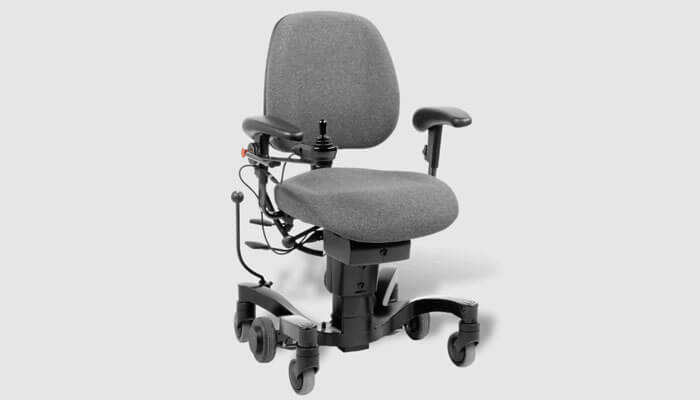
This is the principle behind powered seating designed for rising. Instead of hoisting the user upright like a hospital lift, a well designed height adjustable chair brings the person to a higher sitting position first, so the final step into standing remains their own. That distinction matters. The person still uses their legs and arms, which keeps those muscles working, but the part of the movement that used to be out of reach is taken out of the equation.
Stability is the other half of the picture. A seat that rolls or shifts at the wrong moment is worse than no help at all. Chairs built for this purpose pair height adjustment with armrests to push against and a way to secure the chair before the user rises. It also helps when the chair is not tied to one spot in the living room, since the need to stand up arises at the kitchen counter, the bathroom sink and the wardrobe just as often as in front of the television.
VELA offers a clear example of how this thinking works in practice. Its chairs use electric height adjustment to raise the user to a higher seated position before standing, which reduces the strength and movement needed compared with rising from a low chair. The chair is locked securely first, so the armrests and the user’s own legs can complete the movement on a stable base. Unlike a stationary lift recliner, the same chair can also be moved from room to room while seated, and the design draws on more than 50 years of development and over 500,000 chairs sold worldwide.
For the person using it, the practical result is simple. Standing up becomes something they can do whenever they choose, without first checking whether anyone is around to help.
Protecting Independence Beyond the Chair
A supportive seat works best as part of a wider plan rather than as a standalone fix. The aim is to keep as much natural movement in daily life as possible while removing the moments that carry the highest risk.
A good starting point is an honest look at where standing up actually happens during an ordinary day. Most people find it is far more often than they would guess: getting out of bed, leaving the toilet, rising from the kitchen table, reaching for a shelf, stepping away from a desk. Mapping these moments helps reveal which seats are causing trouble and whether one adaptable chair could replace several difficult ones.
Strength work still has a place. Physiotherapists commonly use repeated sit to stand practice to train the legs, and a seat that can be set at a comfortable height lets someone practise safely, starting higher and lowering it gradually as they grow stronger. Even a few controlled repetitions spread across the day add up, and they keep the movement familiar rather than something to dread.
Dizziness deserves special attention. People who feel lightheaded when they rise should take the transition slowly, pause with their feet flat on the floor, and make sure whatever they are sitting on is secured before they stand. Sudden movements are what turn a brief wobble into a fall. Speaking with a doctor about blood pressure, medication and hydration can also make a noticeable difference.
The emotional side matters as much as the physical one. Asking for help to get up, again and again, can wear on a person’s sense of dignity and on their relationships. Family members often step in out of kindness, yet constant assistance can unintentionally signal that independence is already lost. When the right equipment is in place, relatives can step back from the role of helper and simply be company.
Finally, it is worth involving an occupational therapist where possible. They can assess the home, recommend seat heights, check that armrests and floor surfaces suit the individual, and suggest adjustments as needs change. Independence is rarely about doing everything alone. It is about being able to choose when to move, where to go and when to ask for help, and keeping that choice in the person’s own hands for as long as possible.

Source: Cosmo Politian